
Plant Encyclopedia

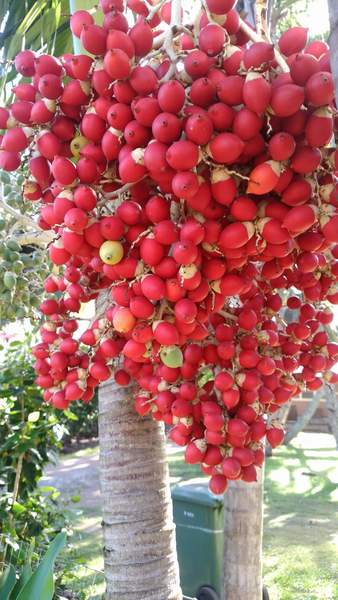
Adonidia merrillii (Christmas palm, "Manirayashi")
Japanese name: マニラヤシ
Scientific name: Adonidia merrillii
[Overview]
A single-trunked palm growing to about 5 m tall.
The internodes of young plants have scales that fall off early.
The trunk bears leaf scars remaining as shallow rings.
The leaves are 2 m long, arch out from the top of the trunk, and number 14–15.
The leaves are fully divided pinnate leaves; the leaflets are lanceolate, 60–70 cm long, and V-shaped in cross section.
Only the leaflets at the base have tips split in two.
The leaf stalk is short.
The flowers are borne in large numbers on spadices that arise singly at the base of the leaf sheath, with both male and female flowers.
The male flowers are 1–1.2 cm long and pale green, and the female flowers are 0.6 cm long.
The fruit is spindle-shaped, about 3 cm long, and ripens glossy bright deep red.
[Cultivation]
Propagate from seed.
It can be grown outdoors in places such as Okinawa, but in areas where temperatures drop to 13°C or lower, grow it in a pot and keep it indoors in winter.
It prefers a sunny site, but direct summer sun can cause leaf scorch, so move it to partial shade.
Plant it in well-drained soil; from spring to autumn, water after the soil surface has dried, and in winter, growth stops, so reduce watering.
Overwatering causes root rot.
From spring to autumn, apply slow-release fertilizer placed on the soil, but if you do not want it to grow large, hold back on fertilizer.
Spider mites and scale insects may occur.
Details
Japanese: マニラヤシ、パラワンヤシ
Translated from our Japanese encyclopedia. If anything differs, the Japanese page is correct.