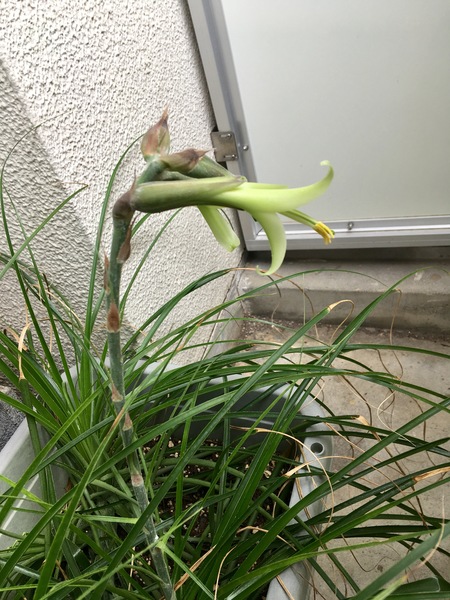
Japanese name: プヤ ミラビリス Scientific name:Puya mirabilis
[Overview]
A perennial that can exceed 1 m when in flower.
Many leaves grow from the base in a rosette; they are linear, 60–70 cm long, with spines along the margins.
A flower stalk more than 60 cm tall rises from the center of the leaves and bears about 15 flowers in a spike.
The flowers are 3-petaled, about 10 cm long and 2 cm across, and pale green.
The calyx is gray-purple to blue-gray.
A plant that has flowered once produces offsets and then dies.
The fruit is a capsule.
[Cultivation]
Propagate by division.
A plant that has flowered once dies after producing offsets, so renew the plants with the offsets.
It prefers sunny, well-drained soil, but direct sunlight in summer causes leaf scorch.
In midsummer place it in bright, airy shade, and in winter place it somewhere sunny such as by a window.
It does better slightly on the dry side; water only after the soil in the pot has dried completely.
From spring to autumn, give diluted liquid fertilizer once a month.
After flowering, cut off the flower stalk so that nutrients go to the offsets.
Pests include aphids and scale insects.