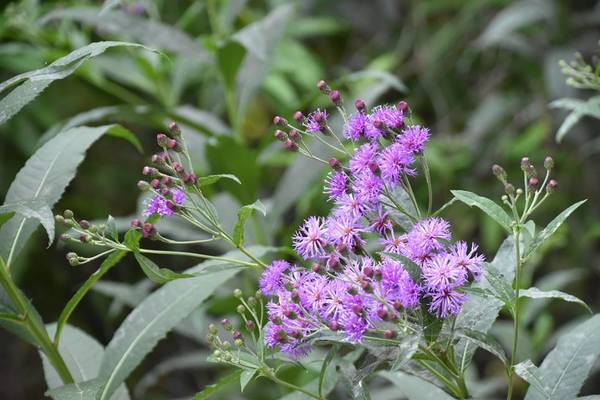
Vernonia noveboracensis(New York ironweed, "Yanagitamuraso")
Japanese name: ヤナギタムラソウ(柳田村草) Scientific name:Vernonia noveboracensis
[Overview]
A perennial 1–2 m tall.
The stem is sometimes sparsely hairy.
The leaves are simple and alternate, linear to lanceolate, 7–20 cm long.
The upper surface of the leaf is rough, and the underside is sparsely hairy or hairless.
The leaf margin is entire or sharply serrated.
Reddish-purple capitula 1–1.5 cm across are borne in cyme-like clusters at the stem tips.
The capitula consist only of tubular flowers.
The fruit is an achene.
[Cultivation]
Propagate from seed, by division, or by cuttings.
It prefers a sunny, well-drained, slightly moist site.
If the environment suits it, it grows well even when left alone.
It also tolerates dryness, so rainfall is sufficient unless summer brings a long spell of sunny weather and the soil becomes severely dry.
Fertilizer is not particularly needed, but slow-release fertilizer may be applied in spring and autumn.
There are no particular pests or diseases.