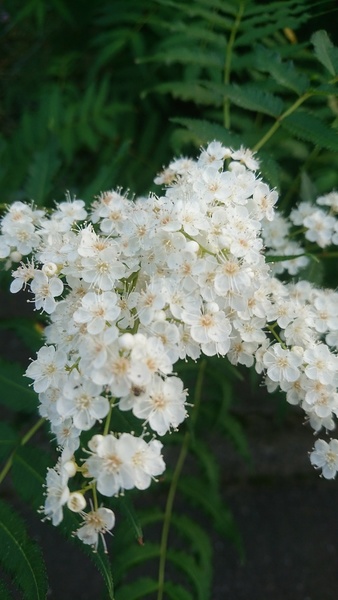
Japanese name: ニワナナカマド(庭七竈) Scientific name:Sorbaria kirilowii
[Overview]
A deciduous shrub about 3 m tall.
It is hairless throughout.
It branches freely.
The leaves are alternate and odd-pinnately compound, consisting of 6–10 pairs (13–21) of leaflets.
The leaflets are elliptic, 4–7 cm long and 1.5–2 cm wide, with 15–23 pairs of lateral veins.
The leaf margins are serrate.
Large panicles at the branch tips bear many densely packed flowers.
The flowers are white, 5-petaled, 5–7 mm across.
There are 20 stamens, shorter than or about as long as the petals.
The fruit is a follicle.
[Cultivation]
Propagate from seed or by cuttings.
It prefers a sunny, well-drained site.
It also grows in partial shade, but flowering is poor if sunlight is insufficient.
Rainfall is sufficient unless summer brings a long spell of sunny weather and the soil dries out.
Apply organic fertilizer around the plant as fertilizer in winter.
Pests and diseases include powdery mildew and longhorn beetle larvae (teppo-mushi).
[Notes]
It resembles Hozaki-nanakamado, but can be distinguished by the number of leaflets and the number and length of the stamens.