
Plant Encyclopedia

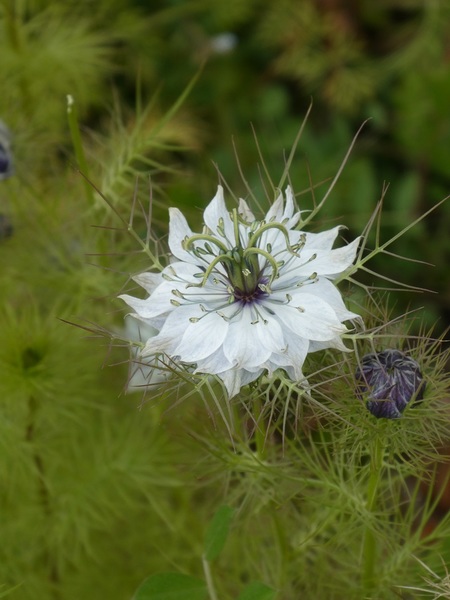
Nigella damascena (love-in-a-mist, "Kurotaneso")
Japanese name: クロタネソウ (黒種草)
Scientific name: Nigella damascena
[Overview]
An annual 20–80 cm tall.
It branches freely.
The leaves are alternate and finely pinnately divided.
The flowers are usually borne singly, facing upward at the branch tips, with an involucre finely divided into threads beneath each flower.
The flowers are about 3.5–4.5 cm across, and the 5 sepals are strongly developed into large petal-like structures that stand out.
The petals are reduced to small nectaries whose tips open in two lips.
There are many stamens.
There are 5 pistils, fused at the base, with horn-shaped stigmas.
Flower colors include blue, white and pink.
The fruit is a balloon-like capsule, with the horn-shaped stigmas remaining at the top.
The seeds are black and contain aromatic compounds.
[History]
It was introduced to Japan in the late Edo period.
[Uses]
The seeds contain aromatic compounds and are used medicinally and as a flavoring.
[Cultivation]
Propagate from seed.
Sow in autumn as a rule.
The optimum germination temperature is 18–20°C; because the seeds are negatively photoblastic and germinate poorly when exposed to light, cover them with a fairly thick layer of soil.
It has a taproot and dislikes transplanting, so sow directly where it is to grow, or sow in plastic pots and then transplant.
It prefers sunny soil that is well drained and retains water well.
For potted plants, water thoroughly when the soil surface dries; for plants in the ground, rainfall is sufficient unless summer brings a long spell of sunny weather and the soil dries out.
Too much fertilizer makes the plants leggy and prone to falling over, so apply only slow-release fertilizer as a base fertilizer.
Aphids can occur.
Details
Japanese: クロタネソウ(黒種草)、ニゲラ、フウセンポピー(風船ポピー)
Translated from our Japanese encyclopedia. If anything differs, the Japanese page is correct.