
Plant Encyclopedia

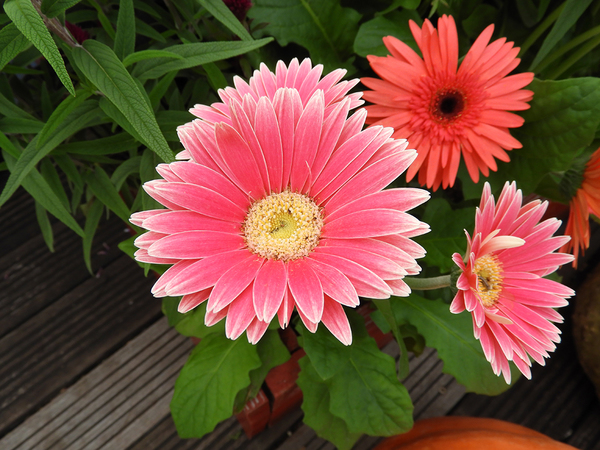
Gerbera (genus)
Japanese name: ガーベラ
Scientific name: Gerbera
[Overview]
A perennial.
The whole plant is densely covered with fine downy hairs.
It has long, cord-like, strong roots, from which side shoots emerge and form clumps.
Many basal leaves with leaf stalks grow in rosettes at ground level from a short stem.
A large flower head is borne singly at the tip of a long, erect flower stalk.
Flower colors are varied, and flower forms include single, semi-double, double and spider types.
[Cultivation]
Propagate by division.
Plants raised from seed tend to show traits different from the parent plant.
Its native region has mild, rainy winters and cool, dry summers, so it dislikes low temperatures and hot, humid conditions.
It can overwinter outdoors if not exposed to frost or freezing.
The optimum growing temperature is 10–20°C; to overwinter it needs night temperatures of 10–12°C, growth stops at 5°C or below, and at 0°C the aboveground part dies back and the plant goes dormant.
During dormancy, for plants in the ground, remove the dead leaves and cover with straw or soil.
It prefers a sunny, well-drained, well-ventilated, fertile soil.
It flowers poorly if the light is poor.
It prefers a somewhat dry place and dislikes excess moisture, so during long rainy spells move potted plants to a place out of the rain.
It is also weakened by direct midsummer sun and high temperatures, so move it to cool, airy partial shade.
A soil pH of 6.0–7.0 is best, and since it dislikes acidic soil, apply magnesian lime when planting.
For planting in the ground, dig deeply and work in compost well, then plant shallowly on a raised mound so that the buds at the base of the plant are not buried in the soil.
For potted plants, water thoroughly when the soil surface dries, and keep it on the dry side in winter.
For plants in the ground, rainfall is sufficient.
In addition to base fertilizer, apply slow-release fertilizer once a month in spring and autumn.
With a fertilizer high in nitrogen, only the leaves grow lushly and flowering becomes poor.
When the flowers finish, snap them off by hand at the base.
Likewise, snap off dead leaves by hand at the base, promptly.
Pests and diseases include southern blight, root rot, powdery mildew, nematodes, aphids and mites.
Details
Translated from our Japanese encyclopedia. If anything differs, the Japanese page is correct.