
Plant Encyclopedia

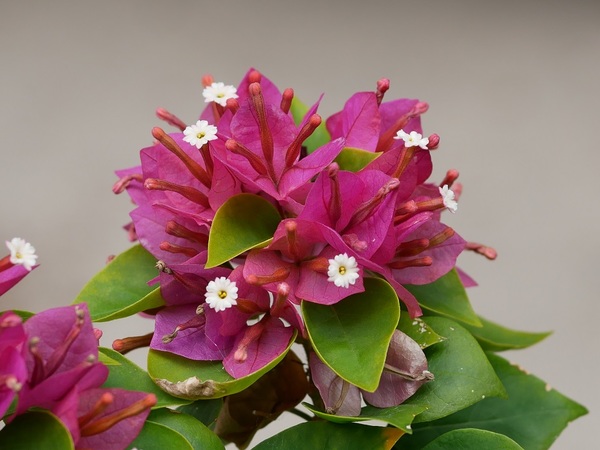
Bougainvillea (genus)
Japanese name: ブーゲンビレア
Scientific name: Bougainvillea
[Overview]
A shrub to small tree with stems that grow long and vine-like.
The leaves are simple, alternate, ovate to elliptic, and entire.
The leaves have petioles.
The flowers are borne singly in the axils of petal-like colored bracts; there is no corolla, and the calyx is tubular.
The calyx is white to pale pink, with the tip shallowly 5-lobed.
The colored bracts come in various colors, such as red, pink, purple, orange and white.
The bracts usually occur in threes.
There are 5–10 stamens.
The fruit is an achene.
[Cultivation]
Propagate by cuttings.
It prefers a sunny, well-drained place.
It does not flower in shade.
In frost-free regions where the temperature stays at 5 °C or above, it can overwinter outdoors, so planting in the ground is possible.
If the temperature is sufficient, it flowers almost all year round.
When planted in the ground, the flowering period is May–October, excluding midsummer.
When new branches have grown, keep it somewhat on the dry side and use less fertilizer, which gives better flowering.
If given too much water or fertilizer, only branches and leaves grow thickly, and flower stalks that did not become flower buds stand out as thorns.
While buds are present and after pruning, water thoroughly when the soil surface dries.
While it is in bloom, water just enough to prevent wilting, and keep it on the dry side in winter.
After flowering, apply a small amount of slow-release fertilizer once every 2–3 months.
The flowers are borne mainly on young short branches.
Cut back branches that have finished flowering hard, leaving 2–3 nodes, and new branches will emerge.
Aphids can occur.
[Notes]
The name commemorates the French navigator and scientist L. A. de Bougainville.
Details
Translated from our Japanese encyclopedia. If anything differs, the Japanese page is correct.