
Plant Encyclopedia

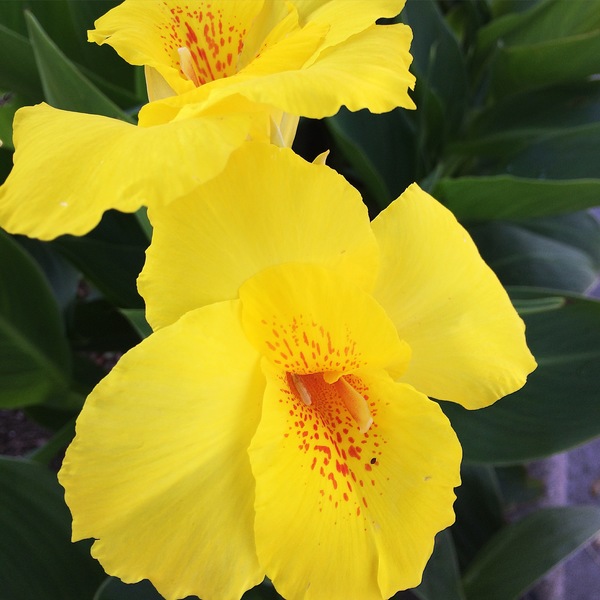
Canna (genus)
Japanese name: カンナ
Scientific name: Canna
[Overview]
A perennial planted in flower beds in summer to autumn.
It has thick, branching rhizomes.
The stems are thick and erect.
The leaves are simple and alternate, oblong to lanceolate with pointed tips and entire margins.
The flowers are borne at the stem tips, enclosed in bracts.
The petals are small and green; of the 6 stamens, 5 develop into petal-like structures and are conspicuous.
The pistil is spatulate.
There are many kinds of cultivars.
Some cultivars have attractive leaf color or striped leaves.
[Cultivation]
Propagate mainly by dividing the bulbs.
It prefers a sunny, well-drained, fertile place.
It is hardy and easy to grow.
For potted plants, water when the soil surface dries.
For plants in the garden, watering is unnecessary unless it becomes extremely dry.
During the growing season from spring to autumn, apply slow-release fertilizer once a month.
It is weak against cold and goes dormant when temperatures fall below 5°C, so when the aboveground part dies back, cut it off and protect the plant from the cold with a covering such as straw mulch to let it rest.
When digging up and storing the rhizomes, prevent them from drying out and freezing.
There are no particular pests or diseases.
Details
Translated from our Japanese encyclopedia. If anything differs, the Japanese page is correct.