
Plant Encyclopedia

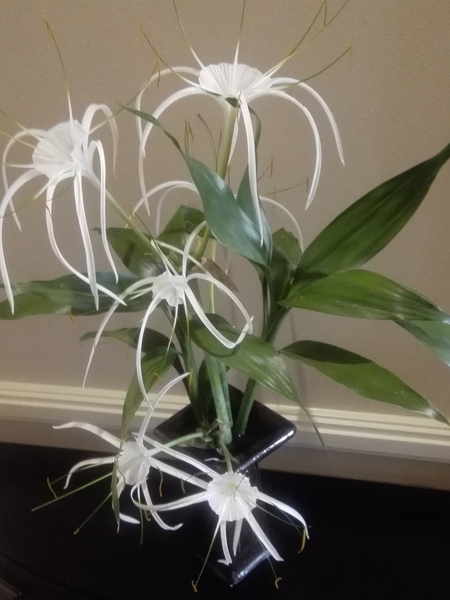
Hymenocallis (genus, spider lily)
Japanese name: ヒメノカリス
Scientific name: Hymenocallis
[Overview]
A perennial.
It has bulbs underground.
Most are evergreen, but some species die back above ground in winter and go dormant.
The leaves are basal, oblong, and the bases are tubular and form the bulb.
At the tip of a long, flat flower stalk, an umbel bears several flowers.
The flowers are white or yellow with 6 petals, which are slender and spread radially.
There are 6 stamens, joined at the bottom by a membrane to form a cup-shaped corona.
Some flowers have a sweet fragrance.
The seeds are large and green.
[Cultivation]
Propagate by dividing bulbs, by scale cuttings, or from seed.
When grown from seed, it takes several years to flower.
Plant bulbs shallowly, so that the top is visible at the soil surface.
It prefers sunny, well-drained, well-aerated sandy soil rich in humus.
Evergreen types are not cold-hardy, so in winter bring them indoors, or when the leaves die back in late autumn, dig up the bulbs, dry them in the shade, bury them in sawdust or peat moss, and store them in a place that does not freeze.
Types that go dormant in winter can overwinter outdoors in areas without frost, and in cold regions are managed in the same way as the evergreen types.
It dislikes excess moisture, so for potted plants water thoroughly after the soil has dried.
For plants in the ground, watering is not particularly necessary, but take care that it does not dry out during flowering.
Cut off water during dormancy.
Little fertilizer is needed; apply slow-release fertilizer as a base fertilizer, and as additional fertilizer, either place a slow-release fertilizer high in phosphorus and potassium on the soil around the time the shoots emerge, or apply liquid fertilizer about once a month during the growing period.
If you do not intend to collect seed, cut the stalk at its base once the flowers are over so that the plant does not tire.
There are no particular pests or diseases.
[Notes]
The alternative name and English name derive from the appearance of the flower with its spreading petals.
Details
Japanese: ヒメノカリス、スパイダーリリー
Translated from our Japanese encyclopedia. If anything differs, the Japanese page is correct.