
Plant Encyclopedia

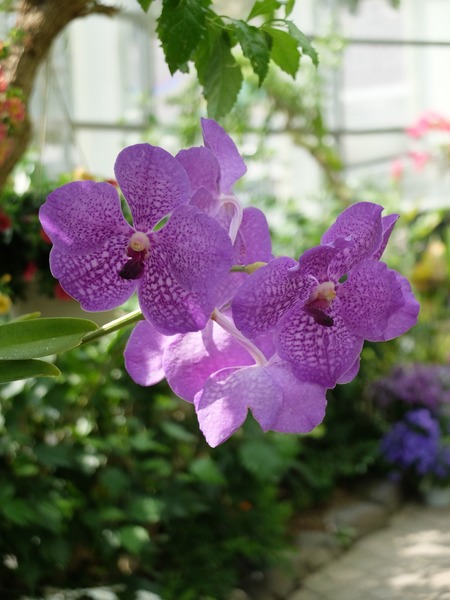
Vanda (genus)
Japanese name: バンダ
Scientific name: Vanda
[Overview]
An evergreen perennial and epiphytic orchid, with about 40 species known in the wild, centered on the tropics of Asia.
It has thick roots.
The leaves are arranged alternately in two rows on an upright stem.
The leaves are either rod-shaped or strap-shaped.
Long flower stalks growing from the leaf axils in the upper part of the stem bear 1 to several flowers.
The flowers are large, and because the sepals and lateral petals are nearly the same shape and color, they are showy.
The lip is 3-lobed, and its base forms a short spur.
[Cultivation]
It is a difficult plant to propagate; increase it by division when side shoots form.
It prefers a hot, sunny, well-ventilated place, and should be kept at 15°C or higher through the winter.
Seedlings are planted in sphagnum moss alone in unglazed pots, but because the roots of flowering plants rot easily when planted in sphagnum moss, they are grown without potting material, fixed as they are in a wooden frame called a basket.
It is good to grow it hanging.
From autumn to winter place it in a sunny spot; in midsummer, types with rod-shaped leaves can be left as they are, but types with strap-shaped leaves should be given about 30–40% shading.
Water every day from spring to autumn, once in the morning and once in the evening when temperatures are high, and once every 2–3 days in winter.
It prefers an environment with high air humidity, and the leaves drop easily when it is dry, so except in midsummer, mist it with water.
In winter in particular the air is dry, so mist frequently or place a humidifier nearby.
From early summer to autumn, apply diluted liquid fertilizer once every 10 days.
There are no particular pests or diseases.
[Notes]
The abbreviation of the genus name is "V."
In the orchid family, where intergeneric hybrids are numerous, abbreviations of the main genus names are sometimes established in order to simplify hybrid formulas and prevent confusion.
Details
Translated from our Japanese encyclopedia. If anything differs, the Japanese page is correct.