
Plant Encyclopedia

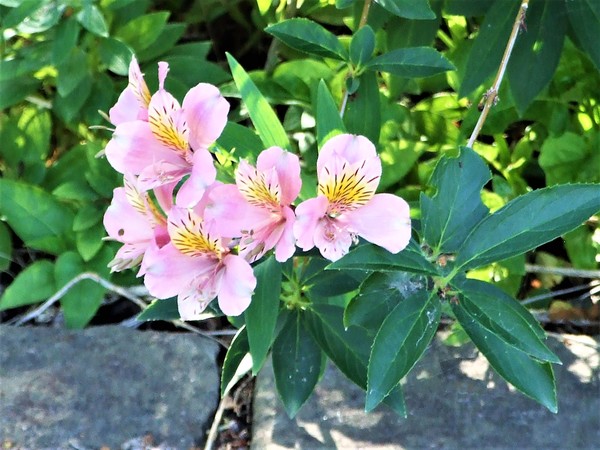
Alstroemeria (genus, Peruvian lily)
Japanese name: アルストロメリア
Scientific name: Alstroemeria
[Overview]
A perennial with fleshy tubers or thickened underground stems.
There are many cultivars, and the flower colors are varied.
The leaves are simple and alternate, broadly lanceolate.
Because the leaf stalk twists, the underside often faces upward.
An umbel-like inflorescence with bracts is produced at the tip of the stem.
The flowers are bilaterally symmetrical and have 6 tepals, 3 inner and 3 outer, but the inner tepals are narrower than the outer ones and are often longer.
Many also have dark streaks (linear markings) on the inner tepals.
There are 6 stamens.
The fruit is a capsule.
[Uses]
It is used mainly as a cut flower, and variegated cultivars are sold as cut foliage.
It is also grown in pots and flower beds.
[Cultivation]
Propagate by division (of the bulbs) or from seed.
It varies with the cultivar, but in general it prefers a sunny, well-drained place.
In hot, humid conditions the roots rot easily.
The rhizomes go deep into the ground, so allow the roots to spread deeply.
For potted plants, move them to a sunny place in spring and autumn, to partial shade to shade in summer, and to a place where they will not freeze in winter.
During the rainy season, keep them out of the rain in a well-ventilated place such as under the eaves or on a veranda.
For plants in the garden, almost no watering is needed.
For potted plants, from spring through the flowering period water thoroughly when the soil surface dries.
After flowering keep them on the dry side, and if they go dormant, do not water.
For plants in the garden, no fertilizer is particularly needed.
For potted plants, from spring through the flowering period give fertilizer placed on the soil once a month or liquid fertilizer once a week.
Depending on the cultivar, additional fertilizer is applied in autumn.
Pests and diseases include gray mold and aphids.
Details
Japanese: アルストロメリア、アルストレメリア
Translated from our Japanese encyclopedia. If anything differs, the Japanese page is correct.