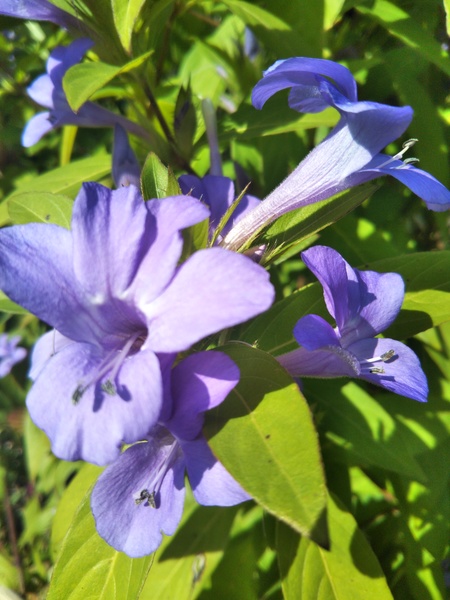
Japanese name: バルレリア Scientific name:Barleria cristata
[Overview]
A shrubby evergreen perennial 1–1.5 m tall.
The leaves are simple and opposite, oblong, 6–10 cm long and 2.5–3 cm wide.
They are entire, with short stiff hairs on both surfaces that make them rough.
Short spikes emerge from the leaf axils in the upper part of the stem.
The flowers are funnel-shaped, 5–6 cm long, 5-lobed at the tip and two-lipped, purplish blue with white stripes.
The floral tube is paler, close to white.
There are also white-flowered forms.
The bracts are large and long-ovate, with spiny margins.
The fruit is an obovate capsule containing 4 seeds.
[Cultivation]
In its native habitat it flowers all year, but in Japan it flowers from summer to autumn.
Propagate from seed or by cuttings.
It prefers a sunny, well-drained place.
The roots develop well, so grow it in a fairly large pot.
It is not cold-hardy, so in winter keep it indoors where the temperature stays at 8 °C or above.
From spring to autumn, water thoroughly when the soil surface dries; in winter keep it on the dry side.
From spring to autumn, apply slow-release fertilizer about once a month.
It tolerates hard pruning.