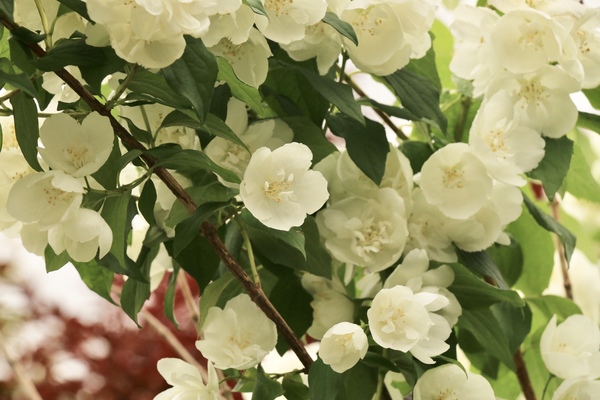
Japanese name: セイヨウバイカウツギ(西洋梅花空木) Scientific name:Philadelphus coronarius
[Overview]
A deciduous shrub growing to 3 m tall.
It branches well and forms a broad crown.
The leaves are simple and opposite, ovate-lanceolate, 3–10 cm long and 2–7 cm wide.
Three veins are conspicuous on the leaf, and the leaf margins have sparse teeth.
There is a petiole.
Racemes arise on twigs growing from the previous year's branches and bear 3–7 flowers.
The flowers are white to milky white, 4-petaled, about 3 cm across.
The flowers have a strong fragrance resembling orange blossoms.
[Cultivation]
Propagate from seed or by cuttings.
It prefers fertile, slightly moist soil that is sunny and well drained.
Avoid places with strong afternoon sun or dry conditions.
For potted plants, water thoroughly when the soil surface dries; for plants in the ground, rainfall is sufficient.
Apply organic fertilizer in early spring, and after flowering give oil cake or similar as thanks fertilizer.
Prune as early as possible after flowering.
Pests and diseases include powdery mildew and scale insects.