
Plant Encyclopedia

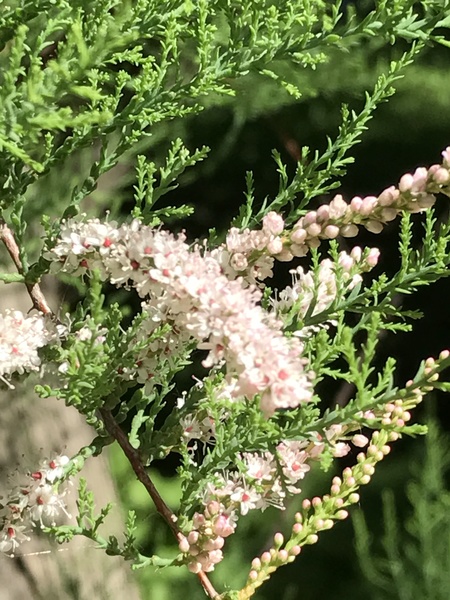
Tamarix tenuissima ("Gyoryu")
Japanese name: ギョリュウ (檉柳、御柳)
Scientific name: Tamarix tenuissima
[Overview]
A deciduous shrub or small tree about 3–6 m tall, found in saline dry land, wetlands, riverbanks, seashores and similar places.
It is a halophyte; the branches and leaves have salt glands that excrete excess salt.
The branches are slender and dense, and either stand upright or hang down.
The older the tree, the more branches hang down.
The leaves are simple and alternate, slender and scale-like, about 1–3 mm long, and cover the branches entirely.
Almost cylindrical compound racemes bear many small, pale pink flowers with 4–5 petals in dense clusters.
The inflorescences that appear in spring come on the previous year's branches, and those that appear afterward come on branches that grew in spring.
The fruit is a capsule.
[History]
It came from China in the Edo period.
[Uses]
The leaves of young branches are used medicinally.
[Cultivation]
Propagate by cuttings and layering, both of which are easy.
Large trees can also be transplanted.
A sunny, well-drained, moist, fertile place is suitable.
Pond edges and the sides of waterways are good.
It is hardy and easy to grow unless the place is extremely dry or the water stagnates.
For potted plants, water thoroughly when the soil surface dries; for plants in the ground, rainfall is sufficient.
For plants in the ground, fertilizing is not particularly necessary unless the soil is poor, but a small amount of oil cake or slow-release chemical fertilizer may be given as fertilizer in winter.
For potted plants, in addition to fertilizer in winter, apply oil cake or slow-release chemical fertilizer once or twice from spring to summer.
It tolerates hard pruning, but it is better to grow it in its natural shape, thinning branches only lightly.
Pests include longhorn beetle larvae (teppo-mushi).
Details
Translated from our Japanese encyclopedia. If anything differs, the Japanese page is correct.