
Plant Encyclopedia

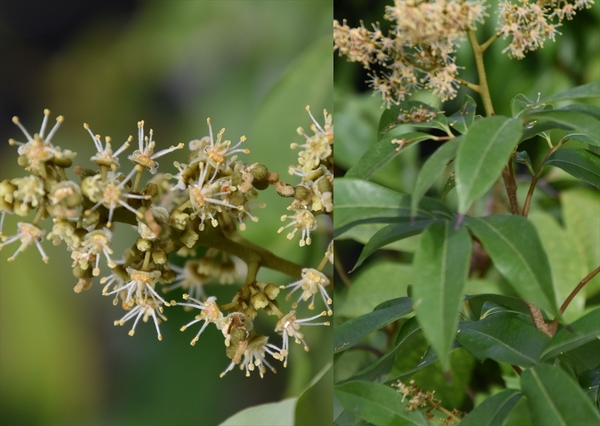
Litchi chinensis (leechee, "Reishi")
Japanese name: レイシ (荔枝)
Scientific name: Litchi chinensis
[Overview]
An evergreen tree about 7–10 m tall.
It branches from a low position.
The bark is gray.
The leaves are alternate and even-pinnate, usually consisting of 3 pairs of leaflets.
The leaflets are lanceolate, 5–16 cm long and 1.5–5 cm wide, and entire.
The underside of the leaves is grayish white.
Panicles arise at the branch tips, and a single inflorescence bears as many as 500–2,000 flowers.
The flowers include male, female and bisexual flowers; they are pale yellow and have no petals.
A single inflorescence bears several dozen fruits, which are spherical or obovate.
The pericarp is hard with a tortoiseshell-like pattern of bumps, and its color varies.
When the pericarp is peeled, there is an edible aril.
The white, translucent aril has a distinctive fragrance and is juicy, both sweet and sour.
Inside the aril are 1–2 large, blackish brown, oblong seeds.
[History]
In China it has been prized since ancient times, and the story is famous of Yang Guifei having it carried by fast horse from southern China to the capital Chang'an.
[Uses]
It is grown as a fruit tree in tropical to subtropical regions.
The seeds, bark, roots and other parts are used medicinally.
[Cultivation]
Propagate from seed, by grafting, by layering and other methods.
The seeds have a short lifespan, so sow them immediately after collecting.
When grown from seed, it takes more than 10 years until harvest, so layering is more suitable.
A temperature of 25°C or higher is required for germination.
It prefers fertile, acidic, sunny, well-drained soil.
It is cold tolerant, but it is desirable to keep it at 10°C or higher even in winter, so it cannot be grown in the open ground except in warm regions and is grown in pots.
From spring to autumn, give it plenty of sun, and in winter move it indoors, such as to a windowsill, where it is protected from frost and cold wind.
From spring to autumn, water thoroughly when the soil surface dries, and keep it on the dry side in winter.
From spring to autumn, apply a chemical fertilizer somewhat high in phosphorus once every 2–3 months.
When fruit sets, thin out those with poor shape or color and let the remaining fruits grow larger.
Harvest after the fruits are fully ripe, but the fruits keep very poorly.
Pests and diseases include scale insects, leafrollers, fruit flies and spider mites.
Details
Japanese: レイシ(荔枝)、ライチ、ライチー
Translated from our Japanese encyclopedia. If anything differs, the Japanese page is correct.