
Plant Encyclopedia

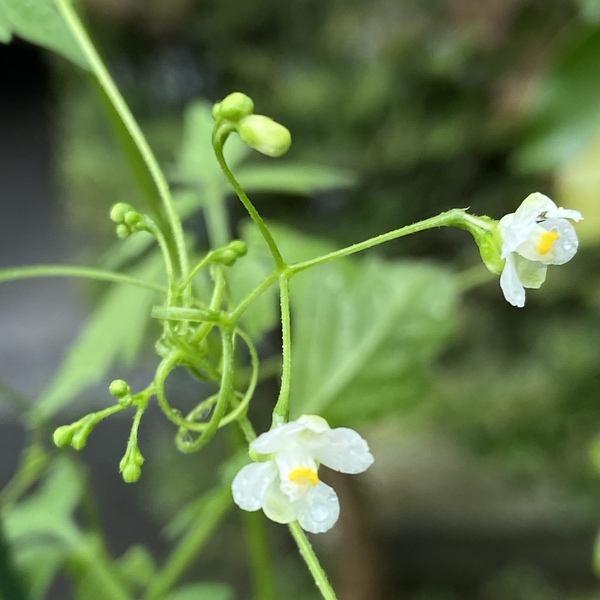
Cardiospermum halicacabum (balloon plant, "Fusenkazura")
Japanese name: フウセンカズラ (風船葛)
Scientific name: Cardiospermum halicacabum
[Overview]
An evergreen climbing perennial, but because it cannot overwinter in Japan, it is treated as an annual.
The vines are slender and grow up to about 3 m.
The leaves are alternate, 5–10 cm long, biternate (twice ternately compound); the leaflets are ovate-lanceolate to ovate with coarse teeth on the margin.
Racemose to corymbose inflorescences with long stalks arise from the leaf axils and bear sparse flowers.
There is a pair of tendrils at the base of the inflorescence.
The flowers are greenish white, 4-petaled, and 3–5 mm across.
The fruit is a capsule that swells like a balloon, about 3 cm across.
The seeds are black and spherical, with a white heart-shaped mark.
[Uses]
It is grown to enjoy its balloon-like fruits, and because of its cool appearance it is also used as a green curtain.
In tropical Asia the young shoots and leaves are edible, and in China the whole plant is used as a folk medicine.
[Cultivation]
Propagate from seed.
The optimum temperature for germination is 20°C or higher, and the seeds do not germinate when it is cold, so sow them around May, when there is no more worry of frost and the temperature has risen sufficiently.
It is not particular about soil as long as the site is sunny and well drained, but it grows better in fertile soil.
It is hardy and easy to grow.
It grows fast, so set up supports early.
For fertilizer, place a slow-release fertilizer high in phosphate and potash on the soil, or apply liquid fertilizer about once a week.
Fertilizer high in nitrogen can cause the fruits to drop.
There are no particular pests or diseases.
Details
Japanese: フウセンカズラ(風船葛)
Translated from our Japanese encyclopedia. If anything differs, the Japanese page is correct.