
Plant Encyclopedia

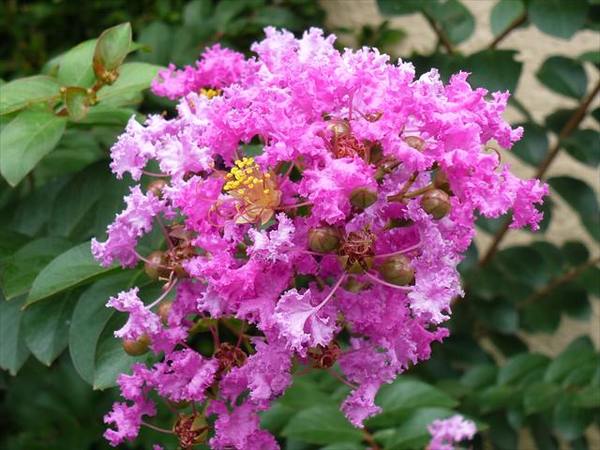
Lagerstroemia indica (crape myrtle, "Sarusuberi")
Japanese name: サルスベリ (百日紅、猿滑)
Scientific name: Lagerstroemia indica
[Overview]
A deciduous shrub or tree 2–7 m tall.
The thin bark of the trunk peels off, leaving cloud-patterned scars and a smooth surface.
The twigs have narrow wings.
The leaves are simple, in two rows alternate or opposite, elliptic to ovate, 2.5–7 cm long and 1.5–4 cm wide, with entire margins.
Panicles 7–20 cm long at the branch tips bear many flowers.
The flowers are pinkish purple to reddish purple or white, 6-petaled and 3–4 cm across, with irregularly crinkled petals.
The flowers begin to bloom from the base of the flower spike.
The fruit is a capsule, and the seeds have wings.
[History]
It came to Japan in the Edo period.
[Uses]
The flowers are called shibika and are used medicinally.
[Cultivation]
Propagate by cuttings.
It can also be grown from seed, but except for the one-year-flowering cultivars it takes years to flower.
As long as the site is sunny and well drained, it is not particular about soil.
In poor sunlight it flowers poorly.
For potted plants and plants within one year of being planted in the ground, water thoroughly when the soil surface dries.
Be careful, because letting it run short of water, especially in summer, reduces flowering.
For plants established in the ground, rainfall is sufficient.
For plants in the ground, apply base fertilizer, and also bury organic fertilizer around the plant as fertilizer in winter.
For potted plants, apply slow-release fertilizer around May, when the branches begin to grow, and during flowering.
Pests and diseases include powdery mildew and scale insects.
[Notes]
The name comes from the smooth bark, which is so slippery that even monkeys, skilled tree climbers, slip on it.
The alternative name hyakujitsukou ("hundred days red") refers to the long flowering period.
Details
Japanese: サルスベリ(百日紅、猿滑)、ヒャクジツコウ(百日紅)
Translated from our Japanese encyclopedia. If anything differs, the Japanese page is correct.