
Plant Encyclopedia

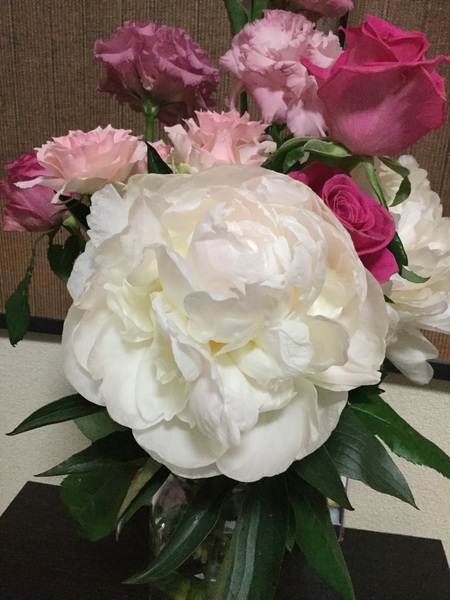
Paeonia lactiflora (Chinese peony, "Shakuyaku")
Japanese name: シャクヤク (芍薬)
Scientific name: Paeonia lactiflora
[Overview]
A perennial 50–90 cm tall.
It has spindle-shaped roots.
The leaves are alternate, 20–40 cm long, once- or twice-ternately compound, and the leaflets are often divided into three lobes.
A large flower is borne singly at the tip of a branch.
The flowers are about 10 cm across and open upward; they are white to pale pink, but garden cultivars range up to deep red, and some have large flowers reaching 18 cm across.
The stamens are yellow and very conspicuous.
The flowers are fragrant.
Garden cultivars are classified by flower form into single, anemone-flowered, semi-double, double and other types.
[History]
In China it was already cultivated as a medicinal herb before the Common Era; in the Jin dynasty (265–316) cultivar names were recorded for flowers offered before the Buddha, and in the Song dynasty (960–1279) records appear of 34 cultivars in 8 grades.
It was introduced to Japan in ancient times as a medicinal plant, and by the middle of the Edo period more than 100 cultivars had been developed.
[Uses]
The roots are used medicinally.
[Cultivation]
Propagate by division.
Take care not to cut the thick roots, and divide into clumps with 3–4 buds each.
It prefers sunny, well-drained, moisture-retentive, fertile soil.
Grow it in an airy place that avoids strong summer afternoon sun and dryness.
For potted plants, water thoroughly when the soil surface dries, and take care that it does not dry out.
For plants in the ground, watering is not particularly necessary unless it becomes extremely dry.
A shortage of fertilizer reduces flowering, so in addition to a base fertilizer, apply slow-release fertilizer in early spring, after flowering, and in autumn.
Pests and diseases include virus diseases, gray mold, powdery mildew, root-knot nematodes, aphids and armyworms.
Details
Japanese: シャクヤク(芍薬)、エビスグサ、ピオニー
Translated from our Japanese encyclopedia. If anything differs, the Japanese page is correct.