
Plant Encyclopedia

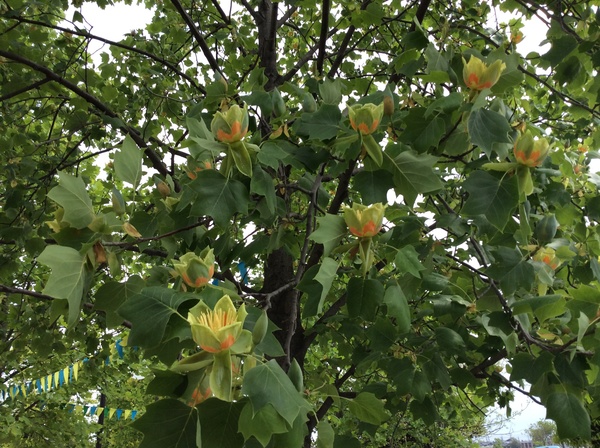
Liriodendron tulipifera (tulip tree, "Yurinoki")
Japanese name: ユリノキ (百合木)
Scientific name: Liriodendron tulipifera
[Overview]
A fast-growing deciduous tree reaching 50 m or more in height and 3 m in diameter.
The tree shape is conical to ovate.
The leaves are simple and alternate, 4–10 cm long, with a distinctive shape: the tip is concave to truncate, and both sides of the base are broad with 1–2 lobes.
The leaf shape varies.
The leaf margin is entire.
The leaves turn yellow in autumn.
The flowers are borne singly at the branch tips; they are six-petaled, upright and cup-shaped.
The petals are yellowish green, 4–5 cm long, with an orange part at the base from which nectar is produced.
The fruits have narrow wings and are gathered in slender cone-like clusters.
It is known to contain a component that inhibits feeding by the gypsy moth.
[History]
It was introduced to Europe in the 17th century and is said to have come to Japan in the first years of the Meiji period.
[Uses]
It is a useful nectar-source tree.
The wood is dense and is used for processed timber, boats and the like.
The root bark is used medicinally.
[Cultivation]
Propagate from seed.
Sow the seeds immediately after collecting, or store them without letting them dry and sow in the following spring.
It prefers a sunny, well-drained, water-retentive, slightly moist, fertile sandy soil.
It is generally hardy but dislikes dry land.
It has a taproot, so it dislikes being transplanted when mature.
Plant and prune during the deciduous period, avoiding the coldest season.
There are no particular pests or diseases.
Details
Japanese: ユリノキ(百合木)、ハンテンボク(半纏木、袢纏木)、チューリップツリー、レンゲボク(蓮華木)
Translated from our Japanese encyclopedia. If anything differs, the Japanese page is correct.