
Plant Encyclopedia

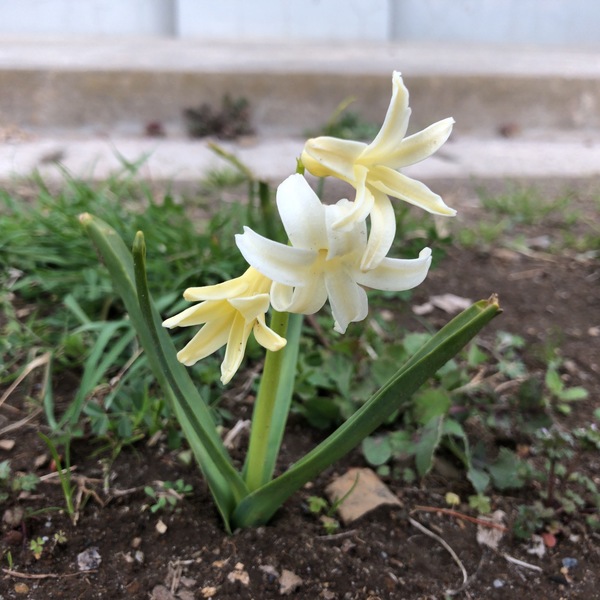
Hyacinthus orientalis (common hyacinth, "Hiashinsu")
Japanese name: ヒアシンス
Scientific name: Hyacinthus orientalis
[Overview]
A perennial with a bulb underground.
The bulb is a layered bulb made up of scale leaves arranged in layers, and its outside is covered with a thin, paper-like outer skin.
The color of the outer skin is almost the same as the flower color.
The leaves are basal, linear, about 20 cm long and 2 cm wide, fleshy, with entire margins.
A thick flower stalk emerges from the center of the leaves, reaches 30 cm in height, and bears many flowers in a raceme.
The flowers are bell-shaped to funnel-shaped and 6-lobed at the tip, and the lobes spread out to curve back.
The flowers come in a variety of colors: blue, purple, red, pink, white and cream.
The flowers have a strong fragrance.
There are two lines: the Dutch hyacinth, bred mainly in the Netherlands, and the Roman hyacinth, bred in France.
The Roman hyacinth is robust and easy to grow, but its flowers are small and sparse, so the Dutch hyacinth is generally more widespread.
[History]
Its cultivation began in 1543 at the Orto Botanico, the world's oldest botanical garden.
Following the tulip in the 17th century, a hyacinth-growing boom arrived in the 18th century, and the bulbs were traded at high prices, partly for speculation.
It arrived in Japan during the Ansei era (1854–1860) of the Edo period, and became generally cultivated after the Taisho period began.
There were once said to be about 2,000 cultivars, but the differences between cultivars are not large, and about 50 cultivars are generally grown today.
[Uses]
Because the flowers have a strong fragrance, they are used as a raw material for perfume.
[Cultivation]
Flower buds do not form unless the plant is exposed to a certain amount of cold, so it flowers better if left to the cold until about the end of November.
Hydroponic culture is common, but planting in soil lets you enjoy the flowers every year.
For hydroponic culture, use bulbs meant for hydroponics and add water so that only the bottom of the bulb is slightly submerged.
Once the roots have grown out, lower the water level by about 2 cm to widen the water surface in contact with the air, so that the bases of the roots touch the air and can breathe.
It grows on the nutrients stored in the bulb, so no fertilizer is needed.
The water becomes dirty, so change it once a week.
Leave it to the cold until the roots emerge, up to about the end of November, and then keep it indoors, which improves the growth of the leaves and flower stalk.
When growing in soil, it prefers sandy, sunny, well-drained, neutral to slightly alkaline soil.
It dislikes acidic soil.
Be sure to plant the bulb the right way up, and plant it shallowly so that the tip just shows above the soil.
From planting until the leaves wither, water thoroughly when the soil surface dries.
In addition to base fertilizer, give liquid fertilizer about once every 10 days from the emergence of leaves until flowering.
It can be left planted for 2–3 years.
In that case, once the leaves wither and the plant enters dormancy, move it to a place where rain does not reach it.
If lifting the bulbs, do so when flowering has finished and the leaves begin to wither.
After lifting, dry them for 2–3 days in an airy, shaded place, remove the stems and leaves, and store them as they are in the same kind of place until planting in autumn.
Propagate by division of bulbs.
The Roman hyacinth divides easily, but the Dutch hyacinth does not, so it is propagated artificially.
Around June–July, make cuts in the bulbs lifted after flowering, in a cross or in three parts, to about half the depth from the bottom.
Disinfect the knife well before use.
After leaving them for 5–7 days in a hot, humid place, store them in a shaded, airy, cool place until planting in autumn, and many small bulblets form on the cut surfaces.
Plant the bulbs bearing these bulblets with the cut surface down, and they become many bulbs the following spring and flower in 2–3 years.
Pests and diseases include soft rot, mosaic disease and nematodes.
[Notes]
The name is said to derive from Hyacinthus, a prince of Sparta in Greek mythology.
Details
Japanese: ヒアシンス、ヒヤシンス、飛信子、風信子
Translated from our Japanese encyclopedia. If anything differs, the Japanese page is correct.