[Overview]
An evergreen with many kinds and varied flowering seasons.
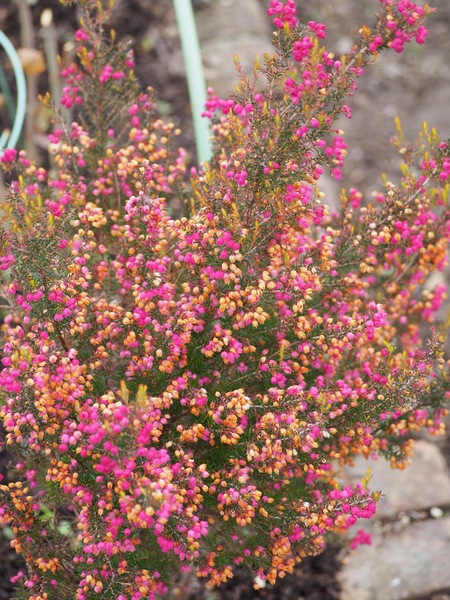
The leaves are usually needle-shaped to linear and small, in whorls of 3 or 6, and often have margins rolled toward the underside.
The flowers are borne singly or in inflorescences such as spikes, racemes or umbels.
The corolla is tubular to urn-shaped and 4-lobed, and the calyx is also 4-lobed.
There are 8 stamens.
In Japan, Janome-erica is popular.
[History]
It is called heath, and heath-covered moorland is famous as one of the representative landscapes of the Atlantic coast of Europe.
[Uses]
It is used for thatching roofs, and for twig brooms and fuel.
Rope is made from the fibers.
Briar pipes are made from the roots of the species Erica arborea.
[Cultivation]
Propagate by cuttings.
European kinds are hardy against cold but weak against summer heat and humidity.
South African kinds are somewhat tender to cold and need -5°C or higher.
It prefers lean, slightly acidic soil in a sunny, well-ventilated place.
It dislikes humidity, so for potted plants, water after the surface soil has dried.
Plants in the garden do not need watering.
Pests include scale insects and aphids.