
Plant Encyclopedia

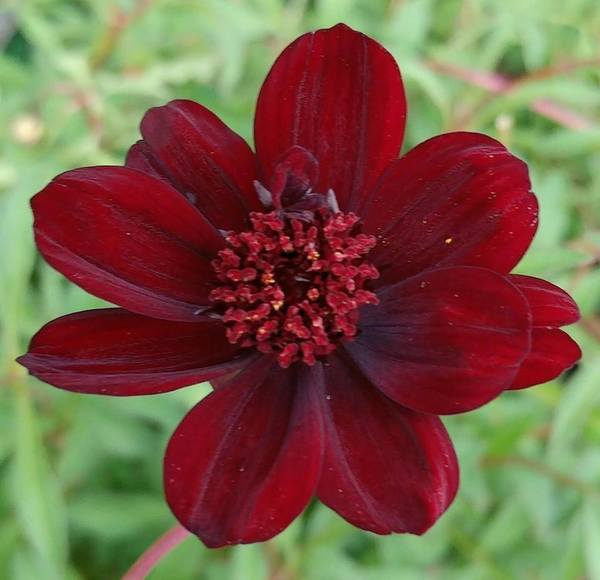
Cosmos atrosanguineus
Japanese name: チョコレートコスモス
Scientific name: Cosmos atrosanguineus
[Overview]
A perennial growing about 30–70 cm tall.
The roots swell like bulbs, and the plant overwinters by these tuberous roots.
The leaves are opposite and pinnately cut.
The flowers are borne singly at the stem tips, are blackish purple to red, and consist of ray florets around the edge and tubular florets in the center.
The wild species has a sweet fragrance, but many garden cultivars have a weak fragrance or none.
[Cultivation]
Propagate by stem cuttings or division.
It dislikes heat and humidity, and in hot regions it often stops flowering in summer.
It prefers a sunny, well-drained place, and from the rainy season through summer, ensure good ventilation.
If it becomes stuffy, the plant weakens.
It also dislikes strong dryness.
Apply fertilizer in spring and autumn.
After the early summer flowers have finished, cutting the stems back by about half will make it flower again in autumn.
It can overwinter outdoors if protected from frost and freezing, but the tuberous roots cannot be dug up and stored dry, so if freezing is likely, move it into a pot to shelter it, or cover it with straw or similar for protection from the cold.
Powdery mildew, aphids and broad mites can occur.
[Notes]
The Japanese name comes from the color of the flowers and their sweet, chocolate-like fragrance.
Details
Translated from our Japanese encyclopedia. If anything differs, the Japanese page is correct.