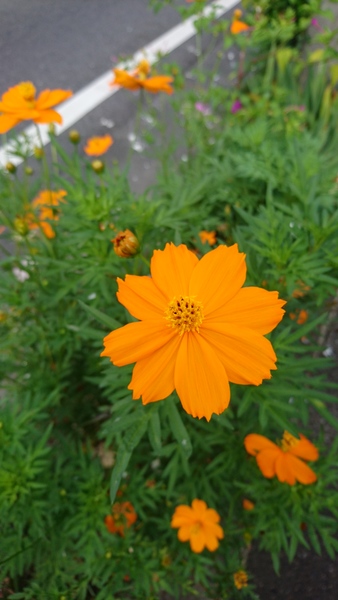
Japanese name: キバナコスモス Scientific name:Cosmos sulphureus
[Overview]
An annual 1–2 m tall.
The stem has 4 ridges and branches freely.
The leaves are opposite and finely pinnately cut, though the lobes are wider than those of cosmos.
The flowers are borne singly at the stem tips.
The flower is a head about 5.5 cm across, made up of ray florets around the edge and tubular florets in the center.
There are usually 8 ray florets, yellow or orange to vermilion red.
The involucral bracts are about 1.3 cm long and have hairs on the margin.
Garden cultivars include semi-double and dwarf forms.
[Cultivation]
Propagate from seed.
It is easy to grow and thrives anywhere sunny and well drained.
In very fertile places it produces only leaves, so poor soil is better suited to it.
For plants in the ground, rainfall is sufficient.
For potted plants, water thoroughly when the soil dries.
Excess moisture and poor ventilation cause disease.
Pests and diseases include powdery mildew, gray mold and aphids.