EVERGREEN

Plant Encyclopedia

Muscari

Muscari (genus, grape hyacinth)

Japanese name: ムスカリ
Scientific name: Muscari

Muscari

[Overview]
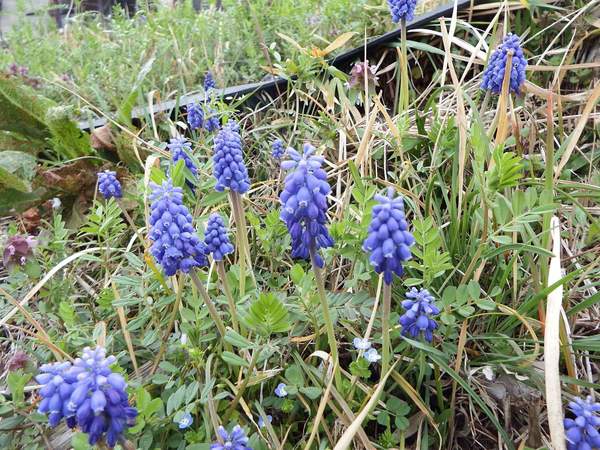
A bulbous perennial of which about 40 species are known in the wild.
Many somewhat fleshy, narrow leaves grow from the base of the plant.
An upright flower stalk bears a raceme at its tip.
The flowers are urn-shaped or tubular and usually grow densely, facing downward.
The flowers are blue-purple or white, but yellow, yellow-green and other colors also occur.
The seeds are round and black.

[Uses]
Several kinds, including Budo-musukari, are cultivated for the purpose of extracting fragrance.

[Cultivation]
Propagate by seed and by dividing the bulbs.
It prefers well-drained, slightly sandy soil.
Care is needed against dryness during the growing season.
It dislikes acidic soil, so apply lime.

Details

Names
English: grape hyacinth
Japanese: ムスカリ、ブドウヒアシンス
Life form
Perennial
Habit
Terrestrial
Planting (or sowing) season
September, October, November
Flowering season
March, April, May
Distribution or origin
Europe, Mediterranean region, Western Asia
Leaf shape
Linear
Leaf arrangement
Basal
Leaf margin
Entire
Inflorescence
Raceme
Flower color
Purple, White, Yellow
Leaf color
Green
Availability of seeds and plants
Low
Form sold
Bulbs
Propagation
Seed, Bulbs
Sun exposure
Full sun
Soil needs
Required
Suitable uses
Potted plant, Flower bed, Parks and gardens, Container, Balcony
Diseases
Southern blight
Uses
Essential oil
Japan Flower Trade Code
15006

Translated from our Japanese encyclopedia. If anything differs, the Japanese page is correct.

Sponsored