
Plant Encyclopedia

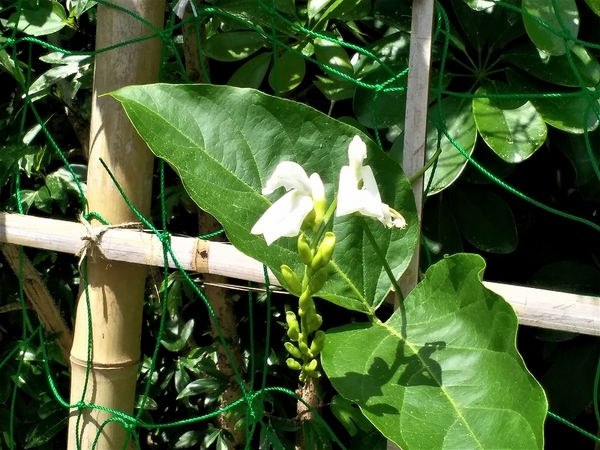
Canavalia gladiata (sword bean, "Natamame")
Japanese name: ナタマメ (刀豆、鉈豆)
Scientific name: Canavalia gladiata
[Overview]
A large climbing annual that grows up to about 4 m.
The leaves are alternate and trifoliate.
The leaflets are ovate with pointed tips.
The flowers are borne in axillary racemes; they are white, pink or reddish purple, pea-shaped, with 10 stamens.
The fruit is a legume, broadly linear and swollen, with 2 ridges developing along the upper suture.
The pods are large, about 20–40 cm long and 3.5–5 cm wide.
[Uses]
Young pods are cut into thin strips and used in fukujin-zuke (a type of pickle).
It is also used medicinally and as a health tea, but it contains toxic substances such as hydrocyanic acid, so when eaten it must be treated, for example by soaking thoroughly in water.
Seeds with characters engraved by laser are sold as gift items.
[History]
It came to Japan in the early Edo period.
[Cultivation]
It prefers a sunny, well-ventilated place and fertile soil, and is sensitive to excess moisture.
After sowing, transplant once the plants have 4–5 true leaves.
When the soil surface dries, water thoroughly.
Propagate from seed.
It is prone to problems from continuous cropping, so do not plant it where legumes have been grown.
Pests include aphids, stink bugs and slugs.
Details
Japanese: ナタマメ(刀豆、鉈豆)、トウズ(刀豆)、タチマメ(太刀豆)、タテハキ(帯刀)
Translated from our Japanese encyclopedia. If anything differs, the Japanese page is correct.