EVERGREEN

Plant Encyclopedia

Anethum graveolens

Anethum graveolens (dill)

Japanese name: ディル
Scientific name: Anethum graveolens

Anethum graveolens

[Overview]
An annual about 30–50 cm tall.
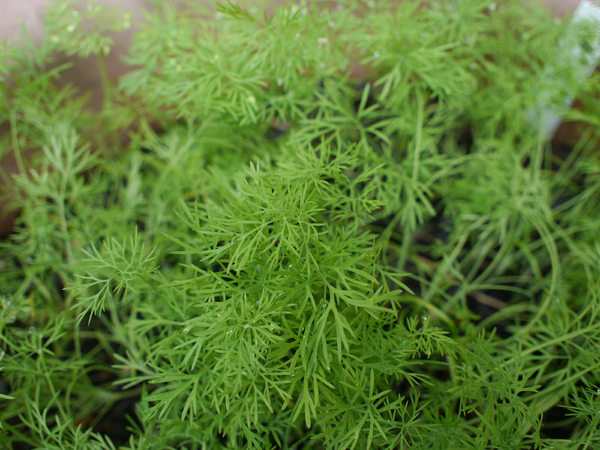
The leaves are alternate and 3–4 times pinnately compound, divided into thread-like segments.
The flowers are yellow with 5 petals, and many are borne in compound umbels about 15 cm across at the stem tips.
The inflorescence lacks both involucels and an involucre, and the inward-curving petals fall early.
The fruit is a schizocarp, flat and elliptic, and separates easily.

[History]
It has been cultivated since at least the 4th century BC.

[Uses]
It has a fragrance similar to fennel, and is used in fish dishes and similar; the fruits and leaves are used to flavor soups and salads.
Dill water is said to have been given to infants as a remedy for gas.

[Cultivation]
It prefers fertile, well-drained, sunny soil.
Propagate from seed.

Details

Names
English: dill, Indian dill
Japanese: ディル、イノンド
Life form
Annual
Habit
Terrestrial
Planting (or sowing) season
March, April
Flowering season
May, June, July
Distribution or origin
Mediterranean coastal region, southern Russia
Growth form
Upright
Height
300–500 mm
Leaf arrangement
Alternate
Inflorescence
Compound umbel
Number of petals
5
Flower color
Yellow
Leaf color
Green
Availability of seeds and plants
Low
Form sold
Seeds, Seedlings
Propagation
Seed
Sun exposure
Full sun
Water needs
Moderate
Soil needs
Required
Suitable uses
Flower bed, Parks and gardens, Container, Balcony
Scent
Spicy
Edible parts
Fruit, Leaves
Uses
Edible, Medicinal
Japan Flower Trade Code
15487

Translated from our Japanese encyclopedia. If anything differs, the Japanese page is correct.

Sponsored