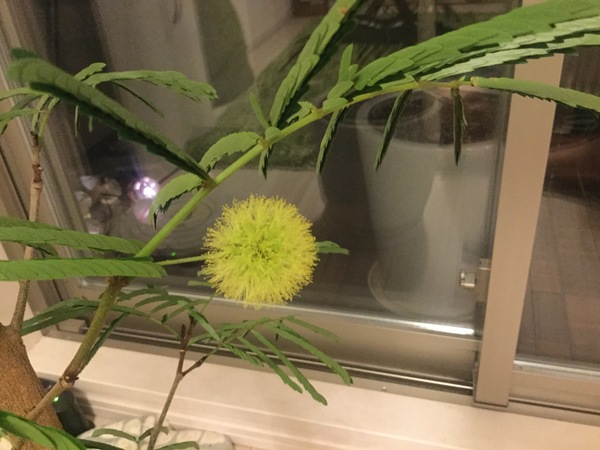
Japanese name: エバーフレッシュ Scientific name:Cojoba arborea var. angustifolia
[Overview]
An evergreen shrub that is said to exceed 30 m in its native habitat.
In cultivation it is often trained to a height of about 2 m.
The leaves are alternate, dark green and glossy, bipinnately compound with an even number of many oblong leaflets.
The leaves close at night and open during the day, a sleep movement (nyctinastic movement).
The flowers are borne in head-like inflorescences, with long cream-colored stamens standing out like a powder puff.
The fruit is a legume twisted in a spiral, constricted between the seeds.
The pods are red and the seeds are black.
[History]
It is said to have been imported by a producer in Okinawa from Bolivia in South America, its native region.
[Cultivation]
Propagate by cuttings.
It prefers a sunny place, but also grows in the weak light indoors.
It dislikes dryness.
[Notes]
At first its scientific name was unknown and it was called Pithecellobium confertum, but from its natural habitat and characteristics it was identified as Pithecellobium sophorocarpum var. angustifolium, and in the current classification it has been moved from the genus Pithecellobium to the genus Cojoba.