
Plant Encyclopedia

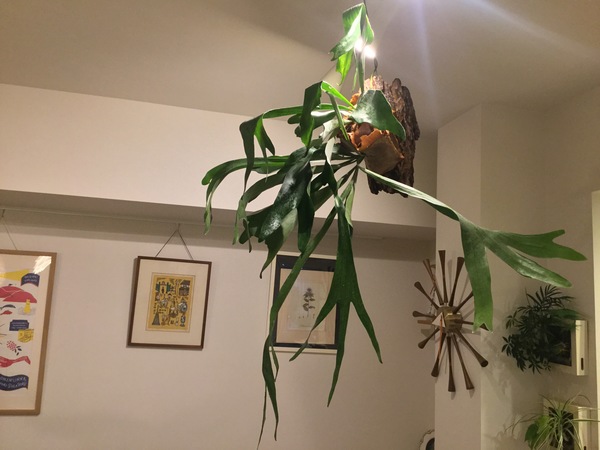
Platycerium alcicorne (staghorn fern, "Komoriran")
Japanese name: コウモリラン (蝙蝠蘭)
Scientific name: Platycerium alcicorne
[Overview]
A large evergreen fern that grows epiphytically on trees.
There are two types of leaves: flat storage leaves (also called bare leaves or mantle leaves) at the base, and spore leaves that resemble deer antlers.
The rhizome is thick and bears scales, many thin roots and leaves.
The leaves are alternate.
The storage leaves reach about 30 cm across, are kidney-shaped with nearly entire margins, and adhere closely to the host tree. They contain water-storing tissue and turn brown early, but do not fall off.
The spore leaves are about 60–100 cm long and leathery; the upper half is wedge-shaped, spreading like a fan, and forks 3–4 times. The leaf lobes are flat and strap-like.
The sporangia are borne over the whole of the terminal lobes except for the tip few mm, or down to a little below the last fork.
[Cultivation]
Propagate by division, though propagation from spores is also possible.
It prefers warm, humid partial shade, but if kept on the dry side in winter it can tolerate temperatures close to 0°C.
For pot culture, fill the pot with tree fern chips or similar and fix the plant in place by wrapping it in sphagnum moss. When mounting on a tree fern board, fix the plant with string with sphagnum moss placed in between.
When the plant grows large and its lower part becomes covered with storage leaves, drainage worsens and the plant weakens, so either make drainage holes in the storage leaves or divide the plant.
Scale insects may attack it, so it is best to kill them as soon as they are found.
[Notes]
Plants cultivated as Komori-ran are often Bikaku-shida.
It is distinguished from Bikaku-shida by its narrower, more deeply cut spore leaf lobes and by the absence of notches on the margin of the storage leaves.
Details
Japanese: コウモリラン(蝙蝠蘭)
Translated from our Japanese encyclopedia. If anything differs, the Japanese page is correct.