
Plant Encyclopedia

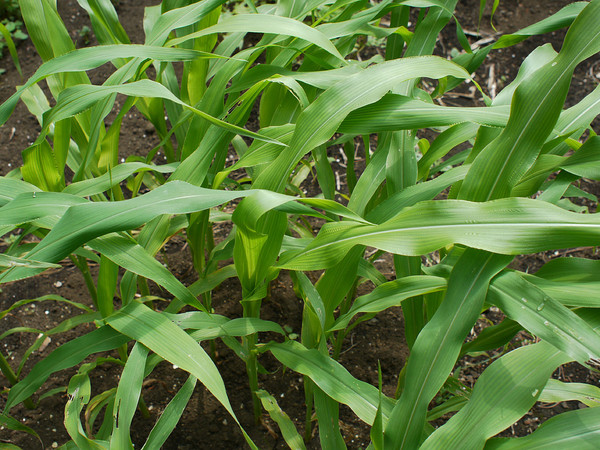
Zea mays (corn, "Tomorokoshi")
Japanese name: トウモロコシ (玉蜀黍)
Scientific name: Zea mays
[Overview]
A large, sturdy annual growing up to 4.5 m tall. Besides its use as a grain, it is an important crop as a raw material for cornstarch and oil and as feed, and is one of the world's three major grains.
The culm (stem) is cylindrical and has nodes.
The plant produces many adventitious roots from its nodes.
The leaves are simple and alternate in two rows, 40–80 cm long and 5–12 cm wide, broadly linear, with the base sheathing and clasping the stem.
The male flower spikes form a panicle at the tip of the stem, while the female spikes are enclosed in bracts, with only the long pistils exposed.
The corn silk corresponds to these pistils.
According to the shape and properties of the fruit, it is classified into popcorn, flint corn, dent corn, sweet corn and others.
[History]
There were two theories about its origin, but the teosinte origin theory is now supported.
In Mexico, a cultivated form is said to have been established by around 3,000 BC.
It is said to have been first introduced to Japan by the Portuguese in the Tensho era, and full-scale cultivation began in the Meiji period.
[Uses]
Sweet corn is eaten as food.
Details
Japanese: トウモロコシ(玉蜀黍)、トウキビ(唐黍)、トーキビ、ナンバ、トウミギ、コーン
Translated from our Japanese encyclopedia. If anything differs, the Japanese page is correct.