EVERGREEN

Plant Encyclopedia

Pseudocydonia sinensis

Pseudocydonia sinensis (Chinese quince, "Karin")

Japanese name: カリン (榠樝)
Scientific name: Pseudocydonia sinensis

Pseudocydonia sinensis

[Overview]
A deciduous tree about 8 m tall.
On old trunks the bark peels off in scales, forming irregular cloud-like patterns.
The twigs have no thorns.
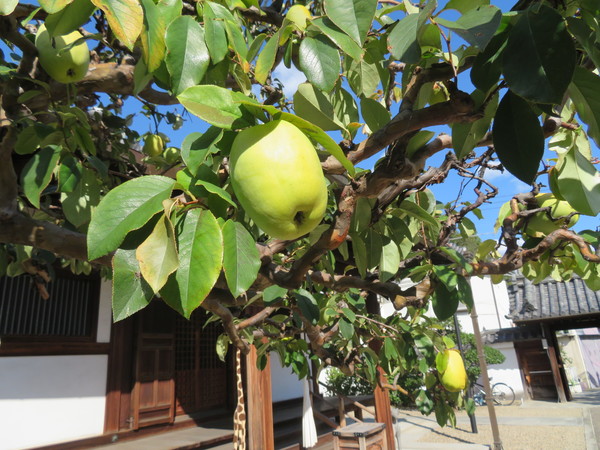
Leaves are simple and alternate, obovate to long obovate, 4–7 cm long, with glandular serrations, and are at first covered with yellowish-white soft hairs on the underside.
Flowers are borne singly in the leaf axils at the tips of short shoots and open in April–May.
The flowers are pale pink, five-petaled, about 3 cm across, and the petals have a short claw at the base.
The fruit is elliptical to obovate-rounded, about 10 cm long, with a hairless surface, and turns yellow and fragrant.

[History]
It was introduced from China in ancient times.

[Uses]
The fruit is hard and strongly astringent, but it is used for sugar preserves and fruit liquor, and also as a cough remedy.
The wood is used for tokobashira (alcove posts), furniture and the like.

[Cultivation]
Propagate from seed, cuttings or layering.
It prefers a cool climate and suits sunny, well-drained, fertile soil.
Pests and diseases include black spot and scale insects.

Details

Names
English: Chinese quince
Japanese: カリン(榠樝)、アンランジュ(安蘭樹)
Life form
Tree
Evergreen / deciduous
Deciduous
Leaf type
Broadleaf
Habit
Terrestrial
Planting (or sowing) season
February, March, November, December
Flowering season
April, May
Fruiting season
October, November
Distribution or origin
Northern China (Hubei; Zhejiang)
Growth form
Upright
Height
8000 mm
Leaf shape
Simple leaf
Leaf arrangement
Alternate
Leaf margin
Serrate
Inflorescence
Solitary
Number of petals
5
Flower color
Pink
Flower diameter
30
Fruit color
Yellow
Leaf color
Green
Availability of seeds and plants
Low
Form sold
Seedlings
Propagation
Seed, Cuttings, Layering
Sun exposure
Full sun
Soil needs
Required
Tolerance
Cold tolerance
Suitable uses
Bonsai, Parks and gardens, Street trees
Hardiness zone
6a, 6b
Diseases
Akaboshi disease, Scab
Pests
Aphids, Scale insects, Borers, Longhorn beetles
Edible parts
Fruit
Uses
Edible, Medicinal, Other
Japan Flower Trade Code
19256

Translated from our Japanese encyclopedia. If anything differs, the Japanese page is correct.

Sponsored