
Plant Encyclopedia

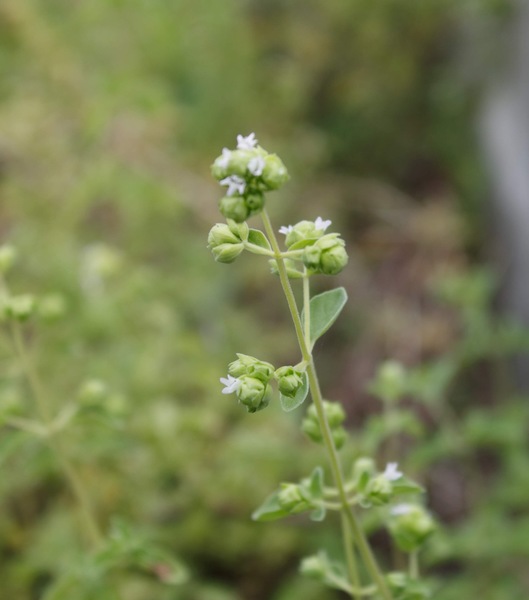
Origanum majorana (marjoram)
Japanese name: マジョラム
Scientific name: Origanum majorana
[Overview]
A perennial 20–50 cm tall.
It is weak to cold, so in Japan it is often grown as an annual.
In its native range it grows on dry, rocky ground.
The stem has 4 ridges, is almost square in cross-section, and becomes woody at the base.
The leaves are simple and opposite, ovate, 0.7–2.5 cm long, with entire margins.
Panicle-like to raceme-like inflorescences form knob-like clusters at the tips of the flower stalks.
The inflorescence is a cluster of spikelets 1.3–2 cm long, accompanied by bracts.
Small white, pink or purple flowers bloom in June–July.
The upper lip of the corolla is 2-lobed and the lower lip is 3-lobed.
Because of its knob-like inflorescences, it is also called knotted marjoram.
[History]
It has been cultivated since ancient times, and in ancient Greece and Rome it was regarded as a herb symbolizing happiness.
[Uses]
The stems and leaves have a fragrance like a slightly sweeter thyme, and are used in meat dishes, tomato sauce and the like.
Fresh leaves have a better fragrance than dried leaves.
Essential oil is also extracted.
[Cultivation]
Propagate by seed, division, cuttings and the like.
It is weak to low temperatures and to heat and humidity, so it is difficult to maintain the plant in Japan.
It seems best to grow it on the dry side.
Details
Japanese: マジョラム、マヨラナ、ノッテッドマジョラム、スイートマジョラム
Translated from our Japanese encyclopedia. If anything differs, the Japanese page is correct.