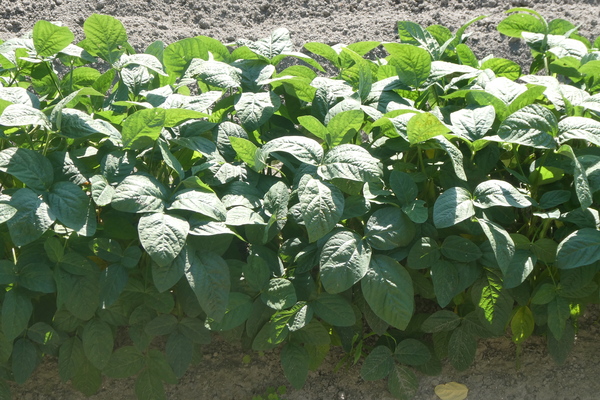
Japanese name: ダイズ(大豆) Scientific name:Glycine max subsp. max
[Overview]
A perennial 30–90 cm tall.
The stem is erect, though some forms are vining. It branches from the leaf axils, and the stems, leaves and pods are hairy.
The leaves are compound with 3–7 leaflets, and the leaflets have entire margins. The stipules are small.
The shape of the inflorescence and the way the stems grow differ by cultivar. Flower color also varies, including white, purple and pale pink.
The pods are mostly about 5 cm long, and immature ones are used as edamame. The seeds (beans) are spherical to elliptical, about 5–10 mm in diameter.
[History]
It is presumed to have originated from Tsuru-mame (wild soybean), which is widely distributed in East Asia, and is said to have arisen in northeastern China, Siberia and the Amur River basin.
It seems to have come to Japan in the Jomon period or the early Yayoi period, and is mentioned in the Kojiki and the Nihon Shoki.
[Uses]
The beans are used for food and for oil extraction.
It is also useful as fodder.
[Cultivation]
Propagate from seed.
It is not particular about soil and tolerates dryness and excess moisture, but pests and diseases are relatively frequent and problems from continuous cropping also occur, so care is needed.