
Plant Encyclopedia

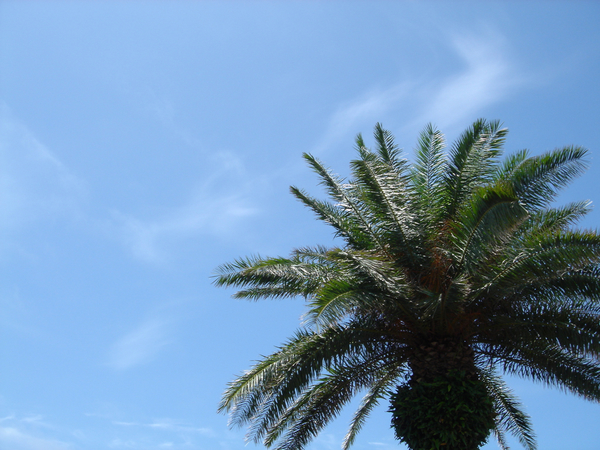
Cycas revoluta (fern palm, "Sotetsu")
Japanese name: ソテツ (蘇鉄)
Scientific name: Cycas revoluta
[Overview]
An evergreen shrub 3–5 m tall that grows on sunny cliffs near the coast.
A gymnosperm.
Dioecious.
The trunk is usually single, thick and cylindrical, and the bases of dead leaf stalks remain on its surface.
Many leaves are borne clustered at the top of the trunk; each is once-pinnately compound, 50–120 cm long, with numerous leaflets exceeding 100 pairs.
The leaflets are slender, 10–20 cm long and 5 mm wide, with a hard texture and pointed tips, and are glossy dark green.
The flowers are borne at the top of the trunk.
The male cones are upright, pointed cylinders 50–70 cm long and 10–15 cm in diameter.
The female cones are feather-like, with 3–5 ovules attached at the base of carpels densely covered with yellowish-brown hairs in the upper part.
The seeds are flat and round, with a glossy red surface.
The Japanese name comes from a tradition that when this tree is about to die, giving it iron revives it (so-tetsu).
[Uses]
The trunk and seeds contain starch, so in the past they were detoxified and eaten as food during famines.
[Cultivation]
Propagate from seed or by division.
It prefers sunny, well-drained sandy soil and is extremely tolerant of drought.
It declines in clay soil where water collects.
It is hardy but slow-growing.
In good sun it develops a compact, strong form, but in shade the leaves become leggy.
It tolerates strong wind and sea breezes well, and has considerable resistance to air pollution.
The best time for transplanting is late spring to summer, and it is often done by planting the bare trunk, with leaves and roots removed, like a cutting.
It can overwinter in the open ground in warm coastal areas up to around Kanto.
With winter protection, it can overwinter as far as southern Tohoku and around Niigata.
Details
Japanese: ソテツ(蘇鉄)
Translated from our Japanese encyclopedia. If anything differs, the Japanese page is correct.