EVERGREEN

Plant Encyclopedia

Chaenomeles speciosa

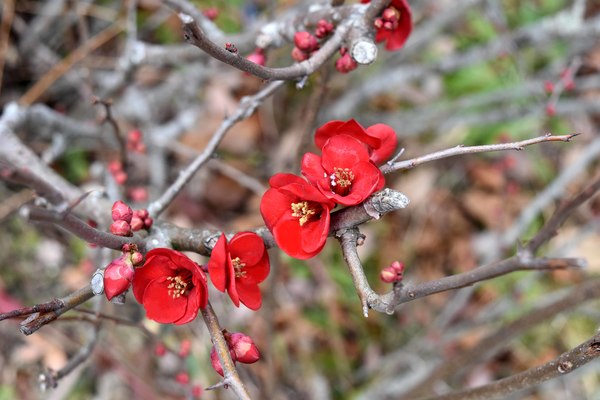
Chaenomeles speciosa (flowering quince, "Boke")

Japanese name: ボケ (木瓜)
Scientific name: Chaenomeles speciosa

Chaenomeles speciosa

[Overview]
A deciduous shrub about 1–2 m tall.
It branches well, and the twigs become thorn-like.
The leaves are oblong to elliptic with serrated margins, and the stipules are kidney-shaped, 1–2.3 cm.
Before the leaves emerge, several flowers at a time are borne in the axils of short branches.
The flowers are 2.5–3.5 cm across, and their color varies: red, scarlet, white, bicolored and so on.
The fruit is elliptic, 4–7 cm long, and ripens yellow.

[History]
It is said to have been introduced during the Heian period, and many horticultural varieties have been created.
Breeding is presumed to have begun in the Edo period, by selecting variants such as those with large flowers or changed flower colors.

[Cultivation]
Propagate from seed, cuttings, root division or root cuttings.
Care is needed against crown gall and cedar-apple rust.

Details

Names
English: flowering quince, Japanese quince
Japanese: ボケ(木瓜)
Life form
Shrub
Evergreen / deciduous
Deciduous
Leaf type
Broadleaf
Habit
Terrestrial
Planting (or sowing) season
September, October, November
Flowering season
March, April
Distribution or origin
China
Growth form
Branching
Height
1000–2000 mm
Leaf shape
Simple leaf
Leaf arrangement
Alternate
Leaf margin
Serrate
Inflorescence
Fascicled
Number of petals
5
Flower color
Red, White, Pink, Multicolor
Flower diameter
25–35
Leaf color
Green
Availability of seeds and plants
Low
Form sold
Seedlings
Propagation
Seed, Cuttings, Root division, Root cuttings
Sun exposure
Full sun
Soil needs
Required
Suitable uses
Bonsai, Potted plant, Hedge, Cut flowers, Parks and gardens
Diseases
Akaboshi disease, Crown gall
Pests
Aphids, Scale insects
Japan Flower Trade Code
19363

Translated from our Japanese encyclopedia. If anything differs, the Japanese page is correct.

Sponsored