
Plant Encyclopedia

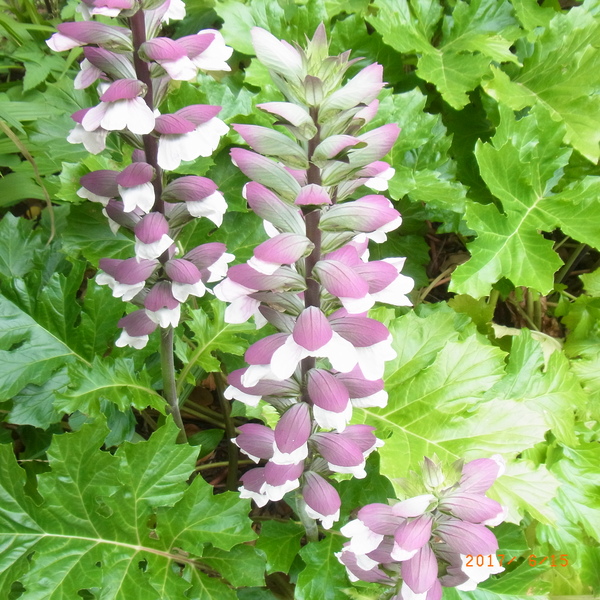
Acanthus mollis (bear's breech)
Japanese name: アカンサス
Scientific name: Acanthus mollis
[Overview]
A large perennial 90–120 cm tall.
The leaves are about 50–60 cm long and 25–30 cm wide, deeply pinnately divided, and glossy on the surface.
The tips of the leaf lobes are pointed but do not become spines.
In about June–September, a sturdy flower stalk up to 2 m tall stands erect and bears a dense spike.
The flowers are white tinged with pale pink, with purple veins.
The flower is a labiate, gamopetalous flower, but because the upper lip is reduced it looks as if the petals were separate.
Looking at a single flower, the upper side of the corolla is covered by a hairless calyx, there are small bracteoles on both sides, and a bract supports it from below.
[History]
It came to Japan in the late Meiji period.
Plants of the Acanthus group have beautiful leaves, so from the time of ancient Greece they were used in the decoration of the capitals of columns in the Corinthian order, a style of Western architecture, and in the acanthus motif in sculpture and painting.
This motif is also seen in Indian Buddhist art and in ancient China.
[Cultivation]
Cultivation is easy; it prefers sunny, well-drained sandy loam, but also grows in partial shade.
Propagate from seed, by division, or by root cuttings.
For seed, sow in February–March; for division, divide the shoots that emerge beside the clump in spring or autumn and plant them.
For root cuttings, cut roots dug up in early spring into pieces of about 3 cm, lay them horizontally, and cover with 1–2 cm of soil.
Details
Japanese: アカンサス、ハアザミ(葉薊)
Translated from our Japanese encyclopedia. If anything differs, the Japanese page is correct.