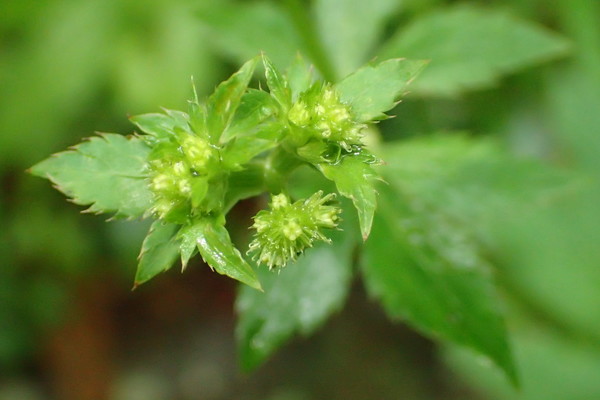
Japanese name: ウマノミツバ(馬三葉) Scientific name:Sanicula chinensis
[Overview]
A perennial 0.3–1.2 m tall, seen in woodlands in the mountains.
The stem is erect and branched.
There are basal leaves and leaves alternate on the stem; both are divided into 3 segments, and the segments are shallowly lobed and toothed.
The lateral segments may be further deeply divided into 2.
Leaves on the lower part of the stem have long petioles, which become shorter on the upper leaves.
Small umbels at the stem tips bear a mixture of male and bisexual flowers.
The flowers are white and 5-petaled, and in the bisexual flowers the ovary is densely covered with hooked bristles.
The fruit is an ovate mericarp densely covered with hooked bristles.