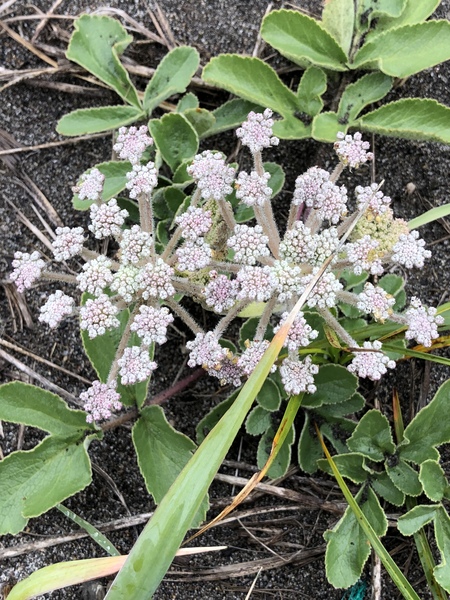
Japanese name: ハマボウフウ(浜防風) Scientific name:Glehnia littoralis
[Overview]
A perennial 5–40 cm tall, found on sandy seashores.
It has a long, burdock-like root.
The whole plant is covered with many white hairs.
The stem branches.
Leaves are alternate and 1–2 times ternately pinnately compound, 2–5 cm long and 1–3 cm wide, thick and glossy.
The leaflets and lobes are rounded and have serrated margins.
Compound umbels at the stem tips bear many small white five-petaled flowers.
The fruit is a broadly oblong mericarp.
[Uses]
The root and rhizome are used medicinally.
The young shoots are used as a garnish for sashimi and the like.
[Cultivation]
Propagate from seed.
It prefers sunny, well-drained, rather dry soil.
The root grows deep, so plant it in a deep pot.
It is better kept on the dry side; water thoroughly after the soil has dried.
In spring and autumn, apply slow-release fertilizer.
There are no particular pests or diseases.