
Plant Encyclopedia

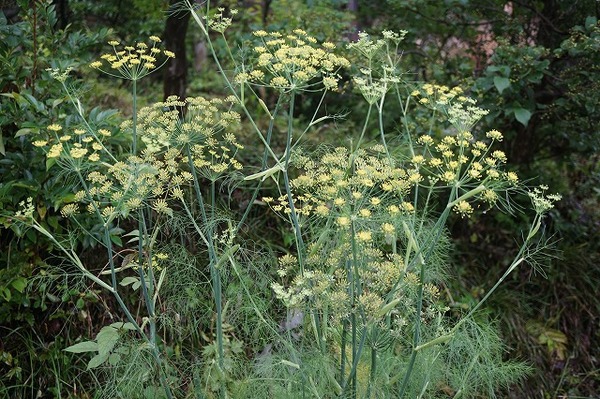
Foeniculum vulgare ("Uikyo")
Japanese name: ウイキョウ (茴香)
Scientific name: Foeniculum vulgare
[Overview]
A perennial 1–2 m tall.
The stems and leaves are gray-green, and the whole plant has a fragrance whose main component is anethole.
The stem is hollow.
Leaves are alternate, about 30 cm long, and 3–4 times pinnately compound, with the lobes divided still more finely.
The base of the leaf stalk clasps the stem, and the stalks of the upper leaves are sheath-like and enclose the young inflorescence.
Compound umbels at the stem tips bear many small flowers.
The flowers are yellow and five-petaled.
There are 10–40 umbellets, and the base of the inflorescence has neither an involucre nor involucels.
The fruit is a cylindrical mericarp about 5–10 mm long, ripening to grayish brown, with a distinctive fragrance.
[History]
It came to Japan in the Heian period and its name appears in the Wamyo Ruijusho.
It is said to have been cultivated in the Edo period.
[Uses]
The stems, leaves and fruit are used as a spice.
It is an herb used especially often to remove the fishy smell from fish dishes, but the leaves are also eaten raw in salads and used in the way parsley is.
The fruit is also used as a flavoring for bread, biscuits, sausages and stuffed dishes.
It also has medicinal effects (diuretic, stomachic, carminative, promoting lactation, relaxing tension, anti-inflammatory), and the fruit has been used as an aromatic stomachic.
In India and elsewhere, there is a custom of eating Uikyo fruit after meals as an aromatic stomachic.
The essential oil (Uikyo oil) is said to be used to flavor foods and liqueurs, and also in toothpaste and soap.
[Cultivation]
Propagate by division or from seed.
It prefers fertile soil with good sunlight and drainage.
Slightly dry conditions are better.
When the plant grows tall, set up a stake so that it does not fall over.
It has a taproot and dislikes being transplanted.
To allow air flow and let sunlight reach the inside of the plant, thin the stems when the stems and leaves become dense.
It is incompatible with tomato, coriander (pakuchi) and legumes, and inhibits their growth, so do not plant it near them.
Stink bugs are a pest.
Details
Translated from our Japanese encyclopedia. If anything differs, the Japanese page is correct.