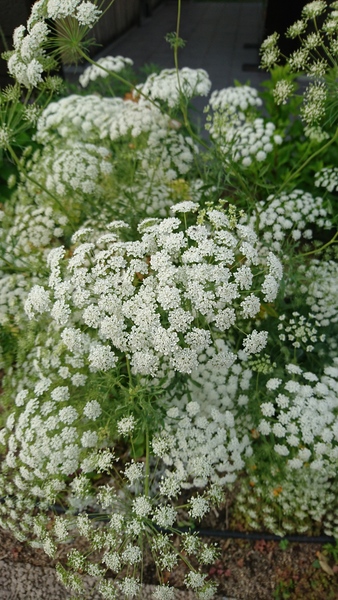
Japanese name: ノラニンジン(野良人参) Scientific name:Daucus carota subsp. carota
[Overview]
An annual or biennial that grows in grasslands and along roadsides, often in colonies.
The stem reaches about 50–200 cm in height.
Unlike Ninjin, the root swells to only about 1 cm across.
Leaves are alternate and 2–3 times pinnately compound, with leaflets finely pinnately divided.
The margins of the lobes are hairy.
Compound umbels at the stem tips bear many dense flowers that are white or tinged with pale pink or purple.
The flowers are small and five-petaled.
At the base of the inflorescence are bracts split into fine threads, which stand erect and enclose the inflorescence after flowering.
The fruit is ovate-oblong and has bristles.
[History]
It has become naturalized widely in the temperate regions of the world, and in Japan it was discovered by Tomitaro Makino in the early Showa era.