
Plant Encyclopedia

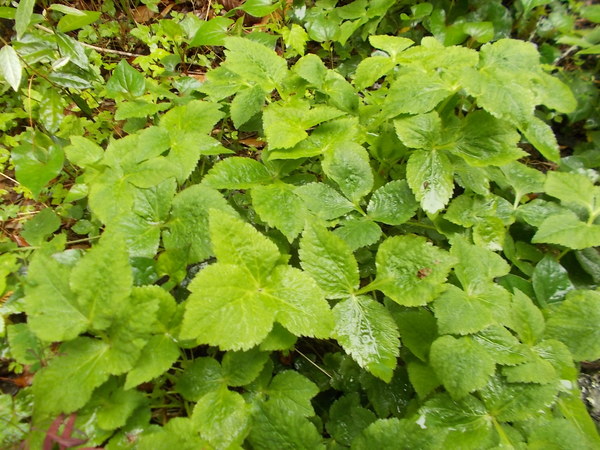
Cryptotaenia canadensis subsp. japonica (mitsuba)
Japanese name: ミツバ (三葉)
Scientific name: Cryptotaenia canadensis subsp. japonica
[Overview]
A perennial 30–90 cm tall.
It grows in moist places in woods and at woodland edges in hills and mountains.
The rhizome is short, and there are thick roots.
The stem is erect and branches in the upper part.
The leaves are alternate and ternately compound; the leaflets are ovate and glossy on both sides.
The leaf margins are doubly serrated.
The petioles are long on the basal leaves and the leaves on the lower part of the stem, and short on the upper leaves.
The base of the petiole forms a membranous leaf sheath that wraps around the stem.
The flowers are small, white and 5-petaled, borne in compound umbels at the branch tips.
The fruit is oblong and ripens black.
[History]
One of the vegetables native to Japan; blanching cultivation began in Mizumoto-cho, Katsushika, during the Kyoho era of the Edo period, and forced blanching cultivation began during the Tenpo era.
[Uses]
The stems and leaves are aromatic and are used as a flavoring vegetable.
It is also used in folk remedies for conditions such as chilblains.
[Cultivation]
Propagate from seed.
Grow it in a well-drained site in sun to partial shade.
The fragrance weakens if there is too little sun.
It is also weak in heat, so it is best to avoid direct sunlight in summer.
The above-ground part may die back if exposed to frost.
When sowing seed, cover it with only a very thin layer of soil.
Until germination, water frequently so that the soil never dries out.
It prefers slightly moist soil and dislikes dryness, so water when the soil surface dries.
Once several true leaves have appeared, give a small amount of chemical fertilizer as additional fertilizer once every 1–2 weeks.
For harvest, cut the plant leaving about 5 cm at the base; new shoots will emerge and it can be harvested again.
Pests and diseases include sclerotinia rot, nematodes and aphids.
Details
Japanese: ミツバ(三葉)、ミツバゼリ(三葉芹)
Translated from our Japanese encyclopedia. If anything differs, the Japanese page is correct.