
Plant Encyclopedia

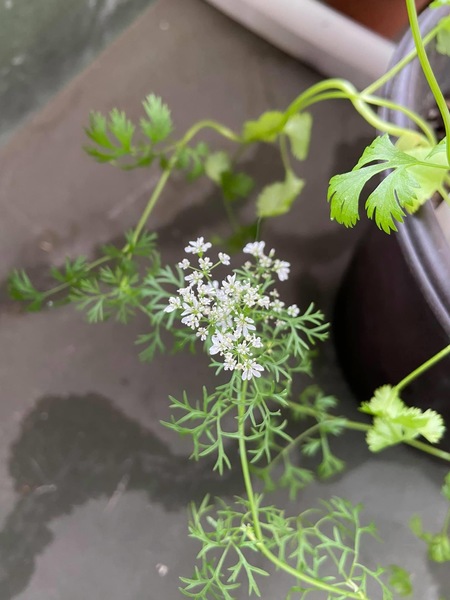
Coriandrum sativum (coriander, "Koendoro")
Japanese name: コエンドロ
Scientific name: Coriandrum sativum
[Overview]
An annual 30–50 cm tall.
The whole plant has a distinctive scent that is likened to that of a stink bug.
There are basal leaves and leaves arranged alternately on the stem; the basal leaves and the leaves on the lower part of the stem are pinnately divided, with broadly ovate leaflets that have serrated margins.
The leaves on the upper part of the stem have linear lobes and entire margins.
Compound umbels at the stem tips bear many white 5-petaled flowers.
The flowers are often tinged with pale purple.
The petals of the flowers on the outer side of the inflorescence are greatly enlarged.
The inflorescence has no involucre, and a small bract is attached at the base of each flower stalklet.
The fruit is a nearly spherical schizocarp.
[History]
It has been used since the time of ancient Egypt, and is said to have already been cultivated in Japan in the Heian period.
[Uses]
The leaves, stems and roots are eaten, and the fruit is used as a spice and for medicinal purposes.
[Cultivation]
Propagate from seed.
It prefers a well-drained site in sun to partial shade.
Water thoroughly when the soil surface dries.
Apply liquid fertilizer once every 1–2 weeks.
When harvesting the leaves, pick them as appropriate, because the leaves become tough once the flowers bloom.
Also, cutting back as part of harvesting encourages plenty of new leaves.
Pests and diseases include aphids and cutworms.
Details
Japanese: コエンドロ、コリアンダー、パクチー、シャンツァイ(香菜)
Translated from our Japanese encyclopedia. If anything differs, the Japanese page is correct.