
Plant Encyclopedia

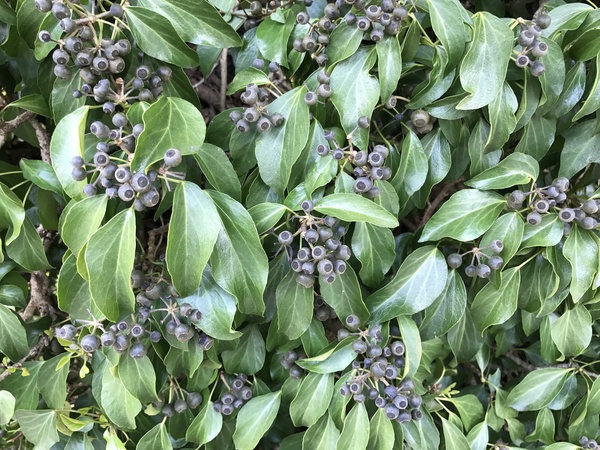
Hedera rhombea (Japanese ivy, "Kizuta")
Japanese name: キヅタ (木蔦)
Scientific name: Hedera rhombea
[Overview]
An evergreen woody climber.
It produces many aerial roots from the trunk and climbs trees, cliffs, walls and the like, reaching 30–40 m in height.
Young branches have yellowish-brown hairs, but these are lost later.
The leaves are simple and alternate, 3–7 cm long and 2–5 cm wide, thick, and glossy on the upper surface.
The leaf margin is entire.
Leaves on young branches are usually large and ovate-orbicular to rhombic-ovate, shallowly 3–5-lobed; leaves on flowering branches are rhombic-ovate to ovate-lanceolate and not lobed.
The petiole is 1.5–5 cm.
Umbels at the branch tips bear one to several small yellowish-green 5-petaled flowers.
The axis of the inflorescence has yellowish-brown hairs.
The fruit is a spherical drupe 6–7 mm in diameter, ripening black.
[Cultivation]
Propagate by cuttings.
For cuttings, cut stems with 2–3 nodes in March–April or September–October.
They root easily when placed in soil or water.
It can also be grown from seed, but the germination rate is poor.
It prefers partial shade and slightly moist, well-drained, water-retentive, airy soil.
For potted plants, water thoroughly when the soil surface dries.
For plants in the ground, watering is unnecessary unless sunny weather continues and the soil dries out.
Fertilizer at planting alone is sufficient.
Pests and diseases include sooty mold, anthracnose, aphids and scale insects.
[Notes]
The alternative name Fuyu-zuta comes from the fact that it keeps its leaves in winter, in contrast to the deciduous ivy of the grape family (Natsu-zuta).
Details
Japanese: キヅタ(木蔦)、フユヅタ(冬蔦)、オニヅタ(鬼蔦)
Translated from our Japanese encyclopedia. If anything differs, the Japanese page is correct.