
Plant Encyclopedia

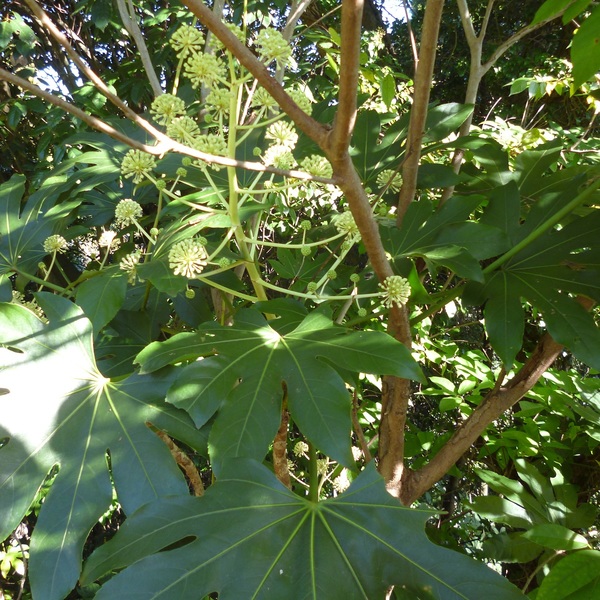
Fatsia japonica var. japonica (glossy-leaf paper plant, "Yatsude")
Japanese name: ヤツデ (八手)
Scientific name: Fatsia japonica var. japonica
[Overview]
An evergreen shrub about 1.5–3 m tall, found in forests near the sea.
The stem branches little, and the half-moon-shaped scars left by fallen leaf stalks are conspicuous.
Young branches are green and at first bear brown hairs, but later become hairless.
Young buds are covered with soft brown hairs.
The leaves cluster at the branch tips and are arranged alternately in a spiral; they are 10–30 cm in both length and width and deeply palmately divided into 5–9 lobes.
The leaves are glossy and somewhat thick, with coarse teeth on the margin.
The leaf stalk is 20–40 cm long.
A large panicle made up of globular umbels extends from the branch tips and bears many flowers.
The flowers are small, white, and have 5 petals.
The axis and flower stalks of the inflorescence are sparsely hairy.
The fruit is a sphere 5 mm in diameter, ripening black, with the style remaining at the tip.
[Uses]
The leaves are used medicinally.
[Cultivation]
Propagate from seed or by cuttings.
Sow the seeds immediately after collecting them.
It has weak cold tolerance, so protection from the cold is needed in cold regions such as northern Honshu.
It prefers partial shade to shade and fertile, well-drained soil.
It grows even in places that receive sun for only 1–2 hours in the morning.
It dislikes strong afternoon sun, dry places, and cold wind.
For potted plants, water thoroughly when the soil surface dries.
For plants in the ground, rainfall is sufficient.
Fertilizer is not particularly necessary, but when the leaves turn yellowish, apply a small amount of oil cake or similar as fertilizer in winter.
Pests and diseases include yellow root rot, anthracnose, yellow spot, and scale insects.
Details
Japanese: ヤツデ(八手)、オニノテ(鬼手)、テングノウチワ(天狗団扇)
Translated from our Japanese encyclopedia. If anything differs, the Japanese page is correct.