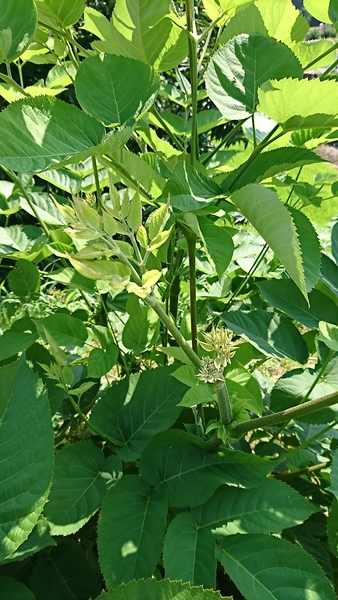
Japanese name: ウド(独活) Scientific name:Aralia cordata var. cordata
[Overview]
A large perennial 1–1.5 m tall, found in collapsed ground and similar places in mountains and fields.
The thick stem stands upright.
The stem has short hairs and sometimes branches.
Leaves are alternate and twice pinnately compound, with long petioles.
The leaflets have short stalks or are stalkless, ovate, 3–30 cm long and 3–20 cm wide, with fine serrations on the margins.
The leaves spread almost horizontally and have short hairs on both sides.
At the stem tip it bears a compound raceme in which spherical umbels gather into a large cone, and many small pale green flowers bloom.
The flowers have 5 petals.
The fruit is spherical, 1–3 mm in diameter, and ripens blackish purple.
[Uses]
The young stems and shoots are gathered as wild vegetables, and the plant is also cultivated.
Blanched plants grown in a dark room without light are also commonly sold.
The rhizome is used medicinally.
[Cultivation]
It prefers a sunny, well-drained place.
Propagate from seed, cuttings or division.