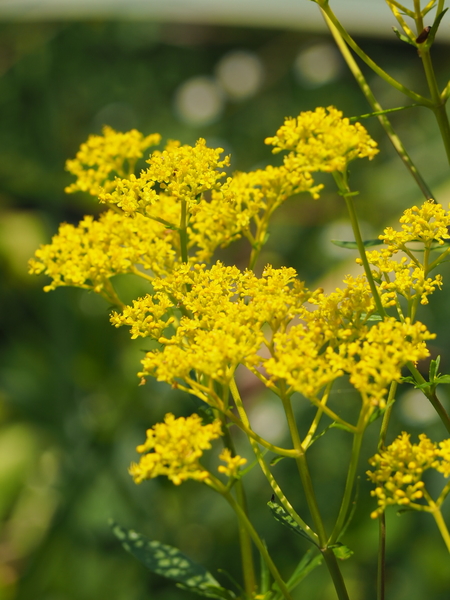
Japanese name: オミナエシ(女郎花) Scientific name:Patrinia scabiosifolia
[Overview]
A perennial 60–100 cm tall, growing in sunny tall-grass meadows in the mountains.
The whole plant has a distinctive odor, and even the water in a vase smells after the stems have been arranged.
It has creeping underground stems.
The stem is erect and branches in the upper part.
Leaves are simple and opposite, deeply pinnately divided.
Cymes at the stem tips bear many flowers.
The top of the inflorescence is almost flat.
The flowers are yellow, 3–4 mm across; the corolla is 5-lobed and there are 4 stamens.
The fruit is oblong, 3–4 mm long; its lack of wings distinguishes it from other plants in the genus Patrinia.
[History]
Long loved as one of the Seven Herbs of Autumn, it appears in the Man'yoshu and The Tale of Genji.
[Uses]
Under the name haisho, it is used as a crude drug.
The young shoots and leaves can be eaten after their bitterness is removed.
[Cultivation]
Propagate from seed or by division.
As long as the site is sunny and well drained, it is not particular about soil.
For potted plants, water thoroughly when the soil surface dries.
For plants in the ground, rainfall is sufficient unless summer brings a long spell of sunny weather and the soil becomes extremely dry.
Even for potted plants, a small amount of slow-release fertilizer in spring is enough.
Damping-off can occur.