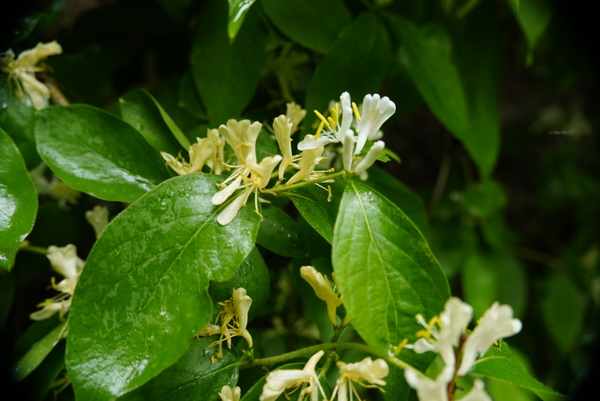
Japanese name: キンギンボク(金銀木) Scientific name:Lonicera morrowii
[Overview]
A deciduous shrub 1–2 m tall.
Young branches have four blunt ridges and are densely covered with short soft hairs.
It branches well.
Leaves are simple and opposite, 1.5–5 cm long and 0.8–3 cm wide, elliptic, wrinkled on the upper surface and densely covered with soft hairs on the underside.
The leaf margins are entire.
The leaf stalks are short and densely covered with soft hairs.
The flowers are borne in pairs in the leaf axils at the branch tips, with bracts at the base, and the flower stalks are densely covered with soft hairs.
The flowers are slightly two-lipped and 5-lobed, white at first and later turning yellow.
The fruit is a spherical berry 0.6–0.8 cm across; two fuse together into a gourd shape and ripen red, but they are poisonous.
[Cultivation]
Propagate from seed or by cuttings.
It prefers sunny, well-drained, fertile soil.
It is easy to grow.
Rainfall is sufficient for watering unless summer brings a long spell of sunny weather and the soil becomes severely dry.
Fertilizer is not particularly necessary.
There are no particular pests or diseases.
[Notes]
The Japanese name includes "kin-gin" (gold and silver) because white and yellow flowers can be seen together.
The alternative name comes from the shape of the fruit.