
Plant Encyclopedia

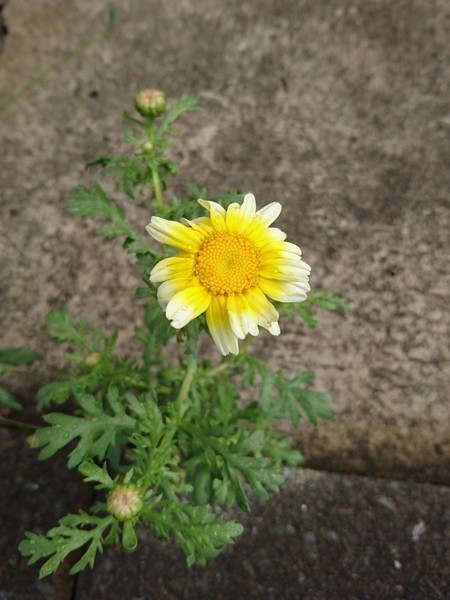
Xanthophthalmum coronarium (Garland chrysanthemum, "Shungiku")
Japanese name: シュンギク (春菊)
Scientific name: Xanthophthalmum coronarium
[Overview]
An annual with a distinctive fragrance.
The leaves are alternate.
The flowers are capitula 3–5 cm across, usually yellow, but they vary, including yellow-and-white bicolors and white flowers.
The fruit is an achene.
There are three strains, large-leaved, medium-leaved and small-leaved, which differ in the strength and quality of their fragrance.
[History]
In Asia it is used as a vegetable, but in Europe, its native region, it is grown as an ornamental.
It is said to have come to Japan in the Muromachi period, and it has been used as a vegetable since the Edo period.
[Uses]
The stems and leaves are used as a vegetable, and in the past it was also used as a medicinal plant.
[Cultivation]
Because its growing period is short, it can be grown and harvested all year round as long as it does not meet extreme heat or cold, but since the optimum growing temperature is 15–20°C, spring and autumn are generally the best seasons for cultivation.
The temperature range in which seeds can germinate is 10–35°C.
The seeds have a dormant period of about two months after sowing.
Once true leaves have emerged, it overwinters without dying even when the temperature falls below 0°C.
It prefers sunny, well-drained, moisture-retentive soil rich in organic matter, and it is sensitive to dryness.
Pests and diseases are relatively few, but watch for anthracnose, which appears in hot periods, and for problems caused by continuous cropping.
[Notes]
The Japanese name derives from its flowering in spring and its leaves resembling those of the chrysanthemum.
Details
Japanese: シュンギク(春菊)、キクナ(菊菜)
Translated from our Japanese encyclopedia. If anything differs, the Japanese page is correct.