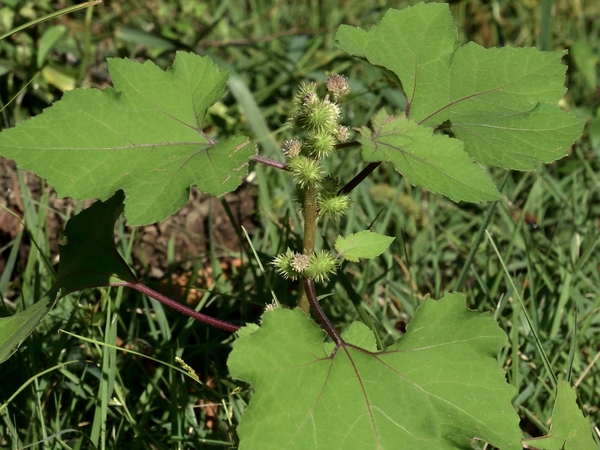
Japanese name: オオオナモミ(大雄生揉、大葈耳) Scientific name:Xanthium orientale subsp. orientale
[Overview]
An annual 0.5–2 m tall, found along roadsides and in vacant lots.
The stem is erect and much branched, ridged, and tinged with purplish brown.
The stem has short hairs and is rough to the touch.
The leaves are alternate, broadly ovate, 5–15 cm long and 4.5–15 cm wide, and 3–5-lobed.
The upper surface of the leaf has fine hairs, and the underside has short hairs and is rough.
The leaf margin has sharp double teeth.
The leaf stalk is long, and there are no spines at the base of the leaf.
There are male and female flowers; the male flowers are yellowish white and borne in short cones in the leaf axils, and the female flowers are pale green and borne in the leaf axils below the male inflorescences.
The fruit is elliptic, with 2 horns at the tip, and is about 1.5–2.5 cm long including the horns.
The surface of the fruit is densely covered with spines whose tips are bent into hooks.
The fruit has almost no hairs.
[History]
It was first recorded in Okayama in 1929 and has since become naturalized in various places.
[Notes]
It is designated an invasive alien species requiring caution under the Invasive Alien Species Act.