
Plant Encyclopedia

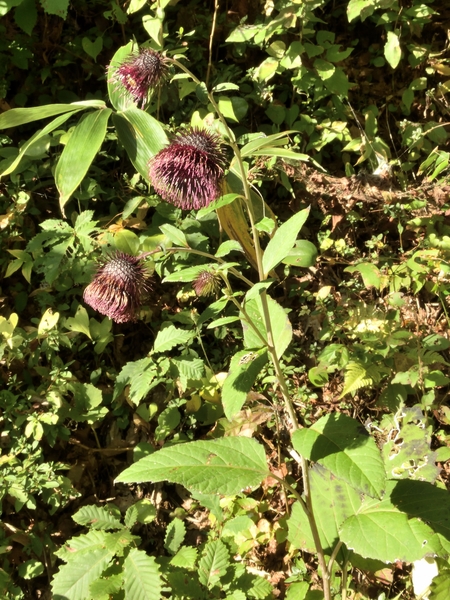
Synurus pungens var. pungens ("Oyamabokuchi")
Japanese name: オヤマボクチ (雄山火口)
Scientific name: Synurus pungens var. pungens
[Overview]
A perennial 1–1.5 m tall, found at the edges of woods in the mountains and in sunny grasslands.
The stem is erect, with cobwebby hairs, tinged with purple, and branches in the upper part.
There are basal leaves and stem leaves, and the basal leaves have withered by flowering time.
The stem leaves are simple and alternate, ovate-elliptic to ovate, with white cottony hairs on the underside.
The leaves on the lower part of the stem are about 15–35 cm long, with petioles 5–20 cm long.
The leaf margin is toothed.
Flower heads 3.5–5 cm across are borne singly at the tips of long stalks.
The heads consist only of purplish brown tubular florets.
The involucre is spherically bell-shaped, 3 cm across.
The involucral bracts are hard, in 13–15 rows, and pointed.
The fruit is an achene 6 mm long with a brown pappus.
[Uses]
The roots are pickled and used as yamagobo, and in some regions the young leaves are used as an ingredient of kusa-mochi (herb rice cakes).
In some areas the downy hairs are used as a binder when making soba noodles.
[Cultivation]
Propagate from seed or by division.
It prefers a sunny, well-drained site.
It grows large, so plant it in a deep pot when growing it in a container.
For potted plants, water thoroughly when the soil surface dries; for plants in the ground, rainfall is sufficient.
In spring and autumn, apply slow-release fertilizer placed on the soil.
There are no particular pests or diseases.
[Notes]
The Japanese name comes from its being more imposing than Yamabokuchi, hence the addition of "o" (male), and from the hairs on the underside of the leaves being used as tinder.
Details
Translated from our Japanese encyclopedia. If anything differs, the Japanese page is correct.