
Plant Encyclopedia

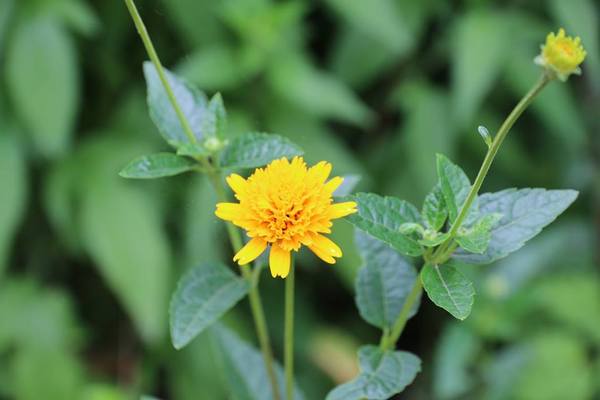
Sphagneticola trilobata (Bay Biscayne creeping-oxeye, "Amerikahamaguruma")
Japanese name: アメリカハマグルマ
Scientific name: Sphagneticola trilobata
[Overview]
An evergreen climbing perennial.
The stems creep along the ground, root at the nodes, and reach 3–5 m in length.
The leaves are simple and opposite, lanceolate to ovate, 5–10 cm long and 2–5 cm wide, but sometimes bird's-foot-shaped; on mature plants they are constricted in the middle and hastate.
The leaf surface is glossy and has stiff hairs.
The leaf margins have low teeth.
A single head-like inflorescence about 4 cm across is borne at the tip of a flower stalk 6–15 cm long.
Both the ray florets and the tubular florets are yellow to orange-yellow.
The ray florets are about 1.3 cm long and shallowly 3-lobed at the margin.
The fruit is an achene with a pappus.
[History]
Plants introduced in the 1970s for greening have become naturalized in Okinawa.
[Cultivation]
Propagate by cuttings.
It can overwinter outdoors in regions without frost.
It prefers a sunny, well-drained site.
It tolerates partial shade, but with poor sunlight it becomes leggy and flowers poorly.
Take care not to let it become too wet; for potted plants, water thoroughly when the soil surface dries, and for plants in the ground, rainfall is sufficient unless summer brings a long sunny spell and the soil becomes severely dry.
If overwintering it, keep it on the dry side in winter.
It needs little fertilizer; for potted plants, place slow-release fertilizer on the soil in spring and autumn, and for plants in the ground none is particularly necessary.
Pests and diseases include gray mold and scale insects.
[Notes]
It is designated an Invasive Alien Species Requiring Caution under the Invasive Alien Species Act.
Details
Japanese: アメリカハマグルマ、ホコガタギク(矛形菊)、ミツバハマグルマ(三葉浜車)
Translated from our Japanese encyclopedia. If anything differs, the Japanese page is correct.